

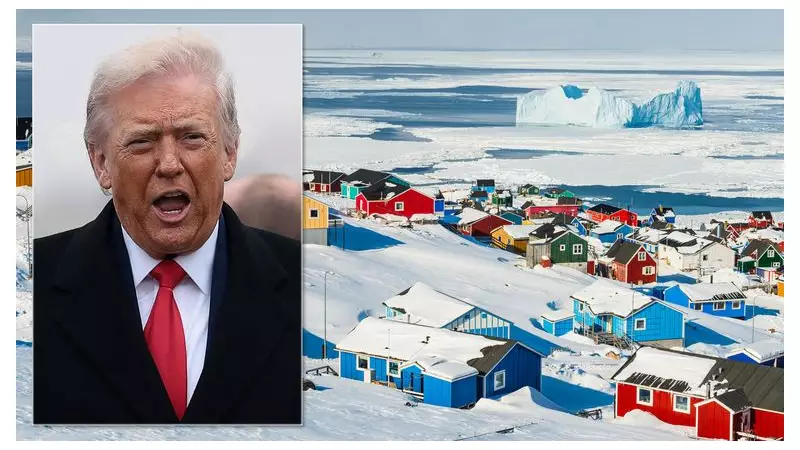
A dramatic threat from former US President Donald Trump to impose punitive tariffs on the United Kingdom and key European allies has plunged transatlantic relations into their most severe crisis for decades, forcing Prime Minister Sir Keir Starmer into urgent crisis talks. The move, centred on the long-standing geopolitical issue of Greenland, represents a significant escalation that has stunned and angered European capitals.
The Trigger: A Military Exercise Misunderstood?
The immediate spark for President Trump's audacious move appears to have been a misunderstanding. Over the weekend, he threatened to apply an additional 10% levy on goods from the UK, Denmark, France, Germany, the Netherlands, Norway, Sweden, and Finland, starting 1 February 2026.
This followed a recent reconnaissance mission to Greenland conducted by those eight European NATO members. Italian Prime Minister Giorgia Meloni, who spoke to President Trump on Sunday morning, suggested the White House may have misinterpreted the military exercise. She indicated it was directed against strategic rivals Russia and China, not the United States.

"There could have been a problem of understanding and communication," Prime Minister Meloni stated. "It seems to me that the risk is that the initiatives of some European countries were interpreted as anti-American, which is clearly not the intention."
Allies rushed to clarify their position in a joint statement issued on Sunday, affirming the exercise, named Arctic Endurance, was "pre-co-ordinated" with Denmark and "poses no threat to anyone." They stressed a commitment to "strengthening Arctic security as a shared transatlantic interest."
Starmer's Diplomatic Tightrope: Negotiation Without Capitulation
The crisis has violently disrupted Prime Minister Starmer's planned "cost of living tour," designed to connect with voters in a crucial election year. Instead, he and his team have been locked in talks in Downing Street and with European allies to formulate a response.
Sir Keir's approach is one of cautious diplomacy combined with firm principle. On Saturday, he labelled the tariff decision "completely wrong" and reiterated that Greenland's future is "a matter for the Greenlanders and the Danes." A senior government figure involved described the strategy: "As before, we're taking a deep breath and using relationships to figure out exactly where the US are before reacting to every social media post."
The Prime Minister will attempt to negotiate with President Trump to see off the tariff threat. However, he will not back down over the fundamental principle of Danish sovereignty. He is expected to argue this week that the tariffs are not sensible and not in the interests of either the UK or the US, while avoiding the more confrontational language used by some European leaders.
A Wider Pattern: Unilateralism and the Unravelling World Order
Analysts see this latest rupture as part of a clear and concerning pattern from the Trump administration, reflecting how global certainties have rapidly come undone. The US appears to be shifting from the cornerstone of the Western alliance to an unpredictable partner.
President Trump has long expressed a desire to annex Greenland, viewing the vast landmass as a strategic asset for American security. Despite Danish offers to significantly expand the existing US security presence on the island under treaty agreements, this has not satisfied the administration's ambitions.
This unilateral approach extends beyond the Arctic. The administration is simultaneously bypassing the United Nations by drawing up a "Board of Peace" to supervise Gaza's transitional administration, asking 60 countries for a $1bn contribution for extended membership. Last week, President Trump also announced an intent to withdraw the US from 66 multilateral forums and retract billions in funding from international organisations.

The implications are deeply worrying. As Liberal Democrat leader Ed Davey stated, the Prime Minister's "US policy lies in tatters" as NATO allies are "punished" for "doing the right thing." The crisis raises alarming questions: Could tensions escalate into a full trade war? What would a disintegration of NATO support mean for Ukraine? In a worst-case scenario, would European armies ever confront the US over Greenland?
For now, the UK and its European partners are united in their message: the tariff threats "undermine transatlantic relations and risk a dangerous downward spiral." While the UK will do all it can to de-escalate the situation, it has drawn a red line on sovereignty. The coming days will test whether diplomacy can prevail over confrontation in this unprecedented standoff.





