

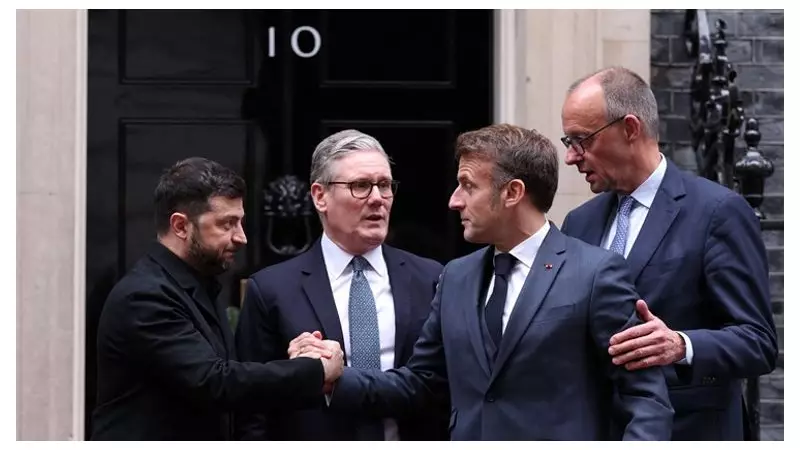
Diplomats and leaders from more than 35 countries are convening in Paris for a critical summit focused on Ukraine's long-term security, a gathering overshadowed by recent geopolitical upheavals from the United States.
The 'Coalition of the Willing' Gathers Amid Global Tensions
The meeting, described as a 'coalition of the willing', includes representatives from over 20 European nations, Turkey, Canada, Australia, and New Zealand. The talks are being held in the shadow of two significant events: Donald Trump's military operation in Venezuela, which resulted in the capture of leader Nicolas Maduro, and the US President's controversial remarks regarding the potential takeover of Greenland, which have strained transatlantic relations.
Key attendees include Ukrainian President Volodymyr Zelenskyy, British Prime Minister Sir Keir Starmer, French President Emmanuel Macron, and Canadian Prime Minister Mark Carney. The United States is represented by President Trump's senior negotiators, Steve Witkoff and Jared Kushner, the latter also being the President's son-in-law.

Five Pillars of Post-Conflict Security
The primary objective of the Paris summit is to devise a robust framework to deter any future Russian aggression, should Moscow agree to a cessation of hostilities in Ukraine. Discussions are centred on five key priorities for the period following a potential ceasefire:
- Establishing effective mechanisms to monitor a ceasefire.
- Providing ongoing support for Ukraine's armed forces.
- Deploying a multinational military force on land, at sea, and in the air.
- Securing concrete commitments from allies in the event of another Russian invasion.
- Forging long-term defence cooperation agreements with Ukraine.
President Zelenskyy has emphasised that security guarantees from Washington are viewed as crucial for unlocking similar commitments from other allied nations. He stated that support could manifest not only as troop deployments but also in the form of 'weapons, technologies and intelligence'.
Hurdles and Essential Commitments
Despite the collaborative spirit, significant hurdles remain. President Zelenskyy acknowledged over the weekend that potential European troop deployments face obstacles, with important details unresolved and 'not everyone is ready' to commit forces. He noted that many national leaders would require parliamentary approval before agreeing to military support for Ukraine.
Zelenskyy singled out the importance of deployments by the UK and France, Western Europe's sole nuclear-armed powers, describing them as 'essential'. 'Speaking frankly as president, even the very existence of the coalition depends on whether certain countries are ready to step up their presence,' he added. 'If they are not ready at all, then it is not really a "coalition of the willing".'
Prior to the Venezuela operation, US negotiator Steve Witkoff had indicated progress in talks, citing 'productive' discussions focused on strengthening security guarantees and developing deconfliction mechanisms. The summit in Paris represents a pivotal attempt to translate these discussions into a concrete, actionable plan, even as the wider geopolitical landscape grows increasingly volatile.






