

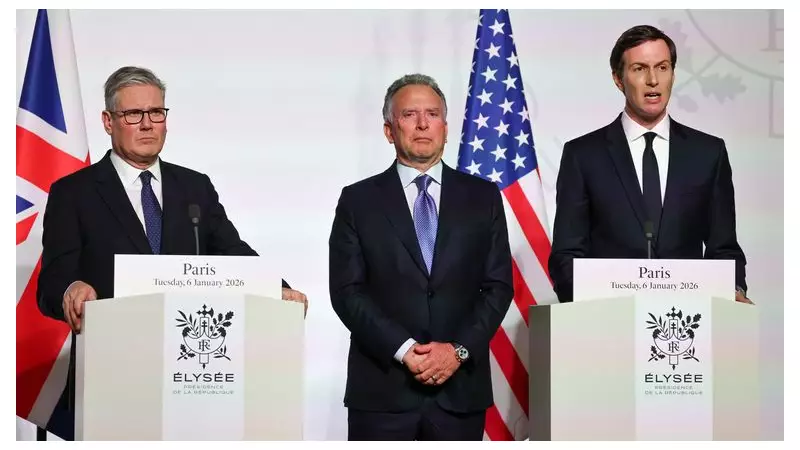
In a significant development for European security, the United States has joined Britain and France in making concrete commitments to underpin a potential peace deal for Ukraine. The high-stakes diplomatic meeting took place in Paris on Tuesday, 6 January 2026, bringing together key Western allies.
A Coalition of the Willing Presents a United Front
The talks, styled as a gathering of a "coalition of the willing," saw Ukrainian President Volodymyr Zelenskyy meet with British Prime Minister Sir Keir Starmer and French President Emmanuel Macron. While an Anglo-French pledge to deploy a multi-national force to Ukraine following a ceasefire was anticipated, the US commitment proved to be the most notable advancement.
Washington has promised to provide a security backstop, effectively a guarantee to respond if Russia were to invade Ukraine again after a peace agreement. This assurance is particularly crucial given the unpredictable and often shifting foreign policy tone from US President Donald Trump.

Kushner and Witkoff Signal Unexpected American Unity
A striking symbol of this transatlantic alignment came during the post-meeting press conference. The unexpected, late addition of senior Trump administration figures Jared Kushner and Steve Witkoff alongside European leaders sent a powerful message of cohesion.
The language used was notably warm, with Witkoff referring to European leaders as "colleagues" and praising Sir Keir Starmer as "incredible." This display of normality stands in stark contrast to the frequently strained European-American relationship witnessed during Trump's presidency. Notably, the contentious issue of Greenland, a recent flashpoint, was set aside to maintain focus on the Ukrainian crisis.
The Glaring Omission: Russia's Vladimir Putin
Despite the progress and show of unity in Paris, the most critical player was conspicuously absent: Russian President Vladimir Putin. His reaction to the proposals remains the great unknown, casting a shadow over the entire initiative.
Key questions now loom large. How will the Kremlin respond to the prospect of NATO member troops being stationed in Ukraine as part of a peacekeeping or observer force? Is President Putin prepared to order a withdrawal of Russian forces from the Donbas region, either partially or completely? Most fundamentally, does the Russian leadership genuinely desire a peaceful resolution, or will it cling to its maximalist demands?
For all the diplomatic momentum generated in Paris, the viability of any deal is entirely contingent on Moscow's willingness to make substantial concessions. The absence of Vladimir Putin from the talks underscores that the most difficult negotiations likely still lie ahead.






