

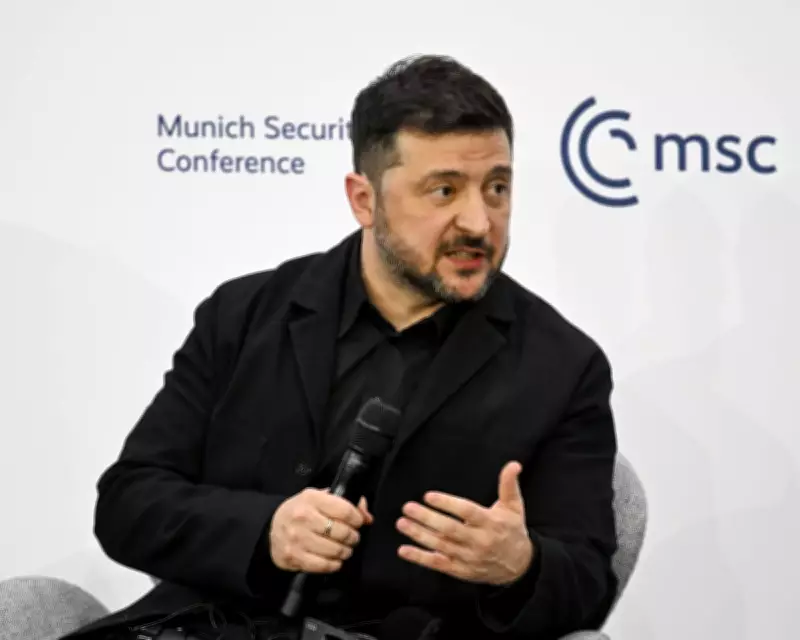
Zelenskyy Insists on Long-Term US Security Guarantee for Ukraine Peace Agreement
Ukrainian President Volodymyr Zelenskyy has declared that Ukraine requires a security guarantee from the United States lasting at least twenty years before it can sign any peace agreement with Russia with dignity. Speaking at the Munich Security Summit on Saturday, Zelenskyy emphasized that this legally binding commitment must outline specific American support for a planned European reassurance force to be stationed inside Ukraine following a peace settlement.
Negotiation Concerns and European Involvement
Zelenskyy expressed apprehension about upcoming trilateral meetings involving Ukraine, Russia, and the United States, stating that he hopes discussions will be substantive and productive. However, he voiced frustration that negotiations often focus disproportionately on Ukrainian concessions rather than reciprocal Russian compromises. The Ukrainian leader specifically questioned Russia's recent decision to change the head of its negotiation delegation, suggesting this move might indicate Moscow is deliberately playing for time rather than pursuing genuine strategic shifts.
Furthermore, Zelenskyy criticized what he perceives as Europe's minimal involvement in the negotiation process, calling this absence "a big mistake" that weakens diplomatic efforts. This perspective reportedly aligns with views expressed by Chinese Foreign Minister Wang Yi, highlighting broader international concerns about European engagement in resolving the conflict.

US Proposals and Conditions
According to Zelenskyy, the United States has thus far offered a fifteen-year security guarantee, falling short of Ukraine's minimum twenty-year requirement. He also disclosed that discussions about a potential "prosperity plan" granting US access to Ukrainian mineral resources have not yet progressed to detailed exchanges. Meanwhile, US Secretary of State Marco Rubio addressed the Munich summit with a diplomatic tone contrasting with previous American statements, emphasizing that "Europe and the US belong together" while simultaneously outlining conditional partnership requirements.
Rubio stressed that American cooperation with Europe remains highly contingent on meeting specific conditions related to climate policy, migration, and tariffs, warning that the United States would proceed independently if these Trumpian demands are not satisfied. Notably, Rubio made minimal reference to Russia's invasion of Ukraine during his address, merely claiming that the US has pressured India to cease importing Russian oil—an assertion that Moscow disputes.
Military Realities and Diplomatic Pressures
Zelenskyy revealed that American officials have suggested Ukrainian withdrawal from the Donbas region could accelerate peace negotiations, but he firmly rejected this proposal since Ukrainian citizens continue to reside in the area. The president also addressed Russian attacks on Ukrainian energy infrastructure, confirming that not a single energy plant within Ukraine has remained unscathed and vowing to raise this destruction during upcoming Geneva talks.
Regarding electoral timelines, Zelenskyy insisted that elections pressed by the United States to occur by May 15 can only proceed two months after a ceasefire declaration, ensuring adequate voter security. This stance responds to pressure from former President Donald Trump, who has urged Zelenskyy to "get moving" toward an agreement with Russia without specifying consequences for Ukrainian inflexibility.
European Pessimism and Regional Dynamics
European leaders attending the Munich summit expressed general gloom about imminent diplomatic breakthroughs, with consensus suggesting Russian President Vladimir Putin remains neither economically nor militarily exhausted. One European official predicted at least two additional years of conflict while asserting that Europe possesses sufficient resources to sustain Ukraine throughout this extended period.

Zelenskyy articulated ambitious military objectives, aiming to increase Russian casualties to fifty thousand per month. He also launched a fierce condemnation of Iran's regime for supplying Shahed drones to Russia, weapons that have caused significant Ukrainian casualties and infrastructure damage. With approximately two hundred thousand protesters demonstrating in Munich against the Iranian government, Zelenskyy argued that "regimes like the one in Iran must not be given time" as they inevitably cause greater destruction when permitted to operate unchecked.
EU Membership Aspirations
Beyond security guarantees, Zelenskyy reiterated Ukraine's desire for European Union membership, calling for a clear accession timeline during his Munich address. Some EU officials have suggested 2027 as a potential entry date, though formal commitments remain pending. This European integration represents a crucial component of Ukraine's long-term strategic vision alongside immediate security assurances from the United States.





