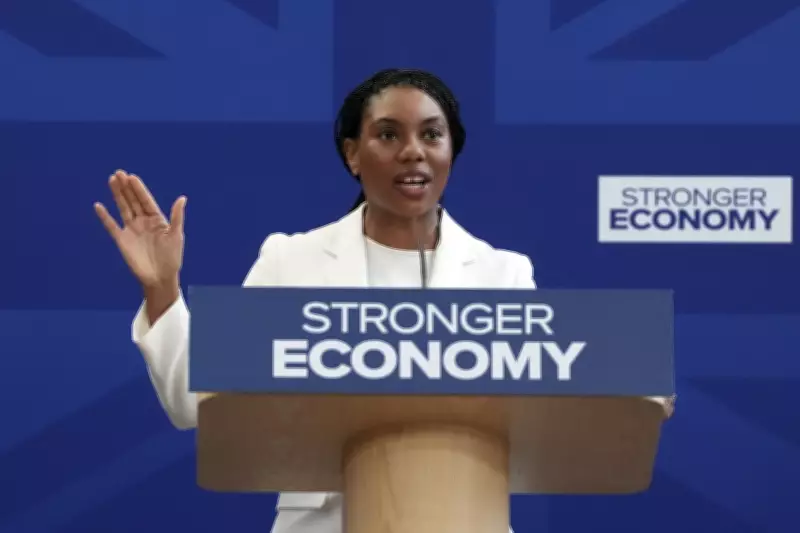
Conservative Party leader Kemi Badenoch has told City AM she wants to deliver 'an economic revolution' in the UK, based on lower taxes, less government intervention and 'a mindset shift' that puts businesses and the City at the heart of the growth agenda.
Economic revolution and tax cuts
Speaking ahead of this week's local elections, the Tory leader says she is developing policies 'based on Conservative principles' and claimed that while 'Keir Starmer did not have any ideas about government…I'm using my time in Opposition wisely.' She recognises that 'we have been hammering business in this country across successive governments, Conservative and Labour, for far too long,' and says her party is now developing 'new policies that take the burdens off business.'
One area that could benefit from a tax cut under a future Badenoch government is the City of London. 'I hate transaction taxes,' she says, revealing that her team is currently engaged in looking at the abolition of stamp duty on shares, a major City bugbear. 'So many people in the City have said this has got to be done [but] for us to do that I need to make sure that the books are balanced.' 'I want an economic revolution,' she says, 'but I've got to make sure we find the funding and the savings first.'

Reducing the size of the state
The size of the state is one area where Badenoch plans to wield the axe, arguing that we are no longer living within our means. 'For a very long time we've assumed that we're a rich country, and what we need is the government to step in [to] make things a bit fairer…so we have all these interventions, all of these schemes.' 'There are thousands of things that the government does,' she says, 'I mean just look at the new quangos Keir Starmer has set up. We don't need these things. It's just more and more government trying to fix problems the government has created.' She says Britain has reached a state where 'the government has got its fingers stuck into everything, and that's one of the things that's shrinking our economy.'
She cites youth unemployment as an example where government changes to the minimum wage and national insurance have made it more expensive to hire, 'and the government is now offering a little bit of a bung to businesses if they can employ a young person on benefits.'
Government needs to get out of the way
Badenoch insists that 'it is not government that creates growth, it is business that creates growth' and that 'government needs to…create the conditions and get out of the way.' She promotes the idea of a state 'doing fewer things but doing them better.' Badenoch also concedes that 'the Conservative brand is still associated with the past' as she attempts to distance herself from the policies of recent Tory governments. On the legally binding push to achieve Net Zero by 2050, introduced by Theresa May, Badenoch says 'I was one of two MPs – the other was a Labour MP – [saying] what on earth are we doing? What is the plan for this?' She also hit out against the decision by former Tory chancellor Jeremy Hunt to extend the windfall tax on energy companies, describing it as 'a terrible idea' and stressing that as Business Secretary she said 'we shouldn't do this.'
Her experience of government may also lead to an overhaul of how Whitehall operates. 'The Business Department was like the customer complaints department for government,' she says. 'All of the complaints came to me, but the decisions were made elsewhere. These are the sorts of things that I want to change.'

Welfare reform and the triple lock
Badenoch recognises that balancing tough decisions on spending with an optimistic message will be a challenge. 'You've got to show people where the New Jerusalem is. You've got to show them that there is hope coming.' Welfare reform is an area of major focus. 'Our first policy announcements have been about bringing down the welfare bill,' she says, adding 'we are now spending more on welfare than we get in income tax. The rider is now heavier than the horse, this is unsustainable.' She is, however, reluctant to include the triple lock on state pensions in her welfare reform agenda. Pushed on the rising cost of the policy, she says 'the triple lock is a symptom of a more fundamental problem, which is growth.' She adds: 'If we were growing at two or three per cent a year the triple lock would not even be a conversation that we're having.'
Asked about her appetite for radical reform, she says 'the challenge that we have is making sure that the numbers add up.' Reflecting on the so-called mini budget of Liz Truss, she says 'the worst thing about that budget was many people assumed that deregulation and tax cuts were the problem when it was the £150 billion of subsidising people's energy bills.' Pushed on whether there are elements of the Truss agenda that she'd like to revisit, she says 'I would like to bring taxes down much lower, but we need to make sure that we can afford it first. That means we need to look at cuts and spending.'