

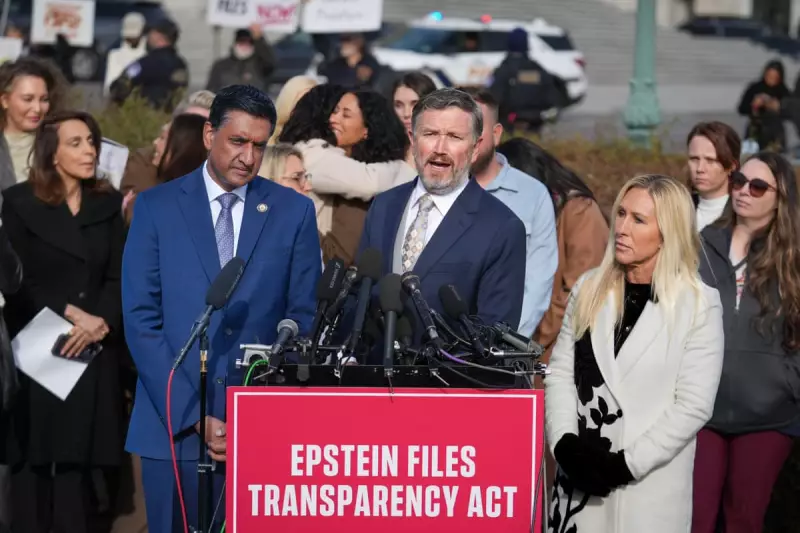
Outrage has erupted in Washington after the US Justice Department, under former President Donald Trump, released only a partial and heavily censored batch of documents related to the Jeffrey Epstein case. This move has been condemned as a direct violation of a federal law demanding near-total transparency.
Lawmakers Promise to Explore 'All Options'
The release has triggered fierce bipartisan criticism, spearheaded by the authors of the legislation that mandated it. Congressman Ro Khanna, a California Democrat, and Congressman Thomas Massie, a Kentucky Republican, co-wrote the Epstein Files Transparency Act. They have jointly accused the department of flouting the law they helped create.
"The justice department's document dump this afternoon does not comply with Thomas Massie and my Epstein Transparency Act," Khanna stated bluntly in a video message. He labelled the disclosure "incomplete" and criticised the excessive number of redactions. The congressman confirmed he and Massie are "exploring all options" in response, which could include holding officials in contempt of Congress or even pursuing impeachment.

Massie echoed this threat on social media, warning that a future Justice Department could prosecute current officials because the Act, unlike a congressional subpoena, does not expire. "Unfortunately, today's document release... grossly fails to comply with both the spirit and the letter of the law," he wrote.
A Clear Violation of the Law
The Epstein Files Transparency Act legally compelled the Justice Department to disclose all its investigative files concerning the late financier and convicted sex offender by 19 December. The law permits limited exemptions to protect ongoing investigations, national security, or the identities of victims, but otherwise mandates full disclosure.
The department's actions on Friday clearly departed from this requirement. Officials had already signalled their intention for a staggered release. Todd Blanche, the Deputy Attorney General and former Trump defence lawyer, stated in a television interview that only "several hundred thousand" documents would come out initially, with more to follow over subsequent weeks.
This "slow-walk" strategy has been interpreted by critics as a tactic to bury sensitive information and minimise public scrutiny.
Bipartisan Condemnation and Demands for Accountability
The criticism was not confined to the law's authors. A chorus of lawmakers from both parties joined the condemnation. Alexandria Ocasio-Cortez, the prominent New York Democrat, accused the administration of an open cover-up. "Protecting a bunch of rapists and pedophiles because they have money, power, and connections," she declared, calling for Attorney General Pam Bondi to resign immediately.
Democratic oversight leaders Robert Garcia and Jamie Raskin issued a joint statement asserting that "Donald Trump and the Department of Justice are now violating federal law." They pledged to examine all legal avenues to force compliance. Senate Democratic Leader Chuck Schumer added that the release violated both "the spirit of transparency and the letter of the law," promising that Senate Democrats would pursue every option to uncover the truth.
In a defensive response on social media, the Justice Department's media account insisted it was complying with the law, pointing to the inclusion of unredacted photos of figures like former President Bill Clinton as evidence of transparency. Clinton has previously denied any wrongdoing related to Epstein.
The controversy sets the stage for a significant political and legal confrontation, as Congress weighs its powers to compel the executive branch to adhere to the transparency law it passed.






