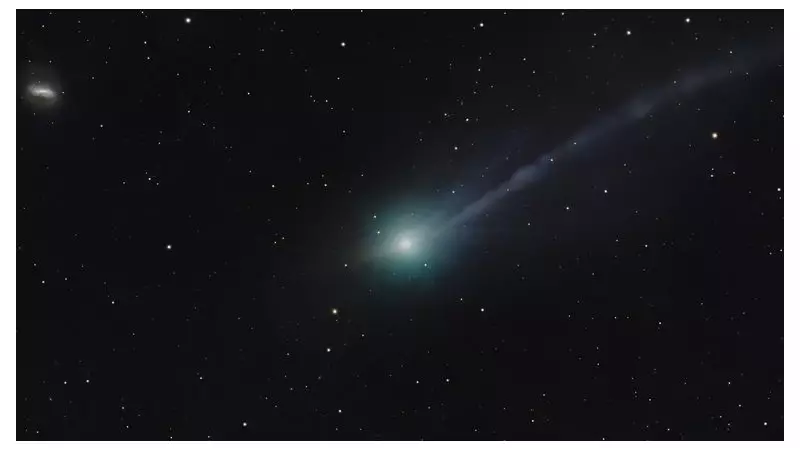
A mysterious object from deep space, which a prominent Harvard scientist controversially suggests could be of extraterrestrial origin, made its closest pass by Earth on Friday, 19 December 2025, igniting a fierce row within the scientific community.
The Close Encounter and Conflicting Theories
Known as 3i/ATLAS, the high-speed object raced past our planet at approximately 130,000 miles per hour. It maintained a safe distance of around 170 million miles—roughly twice as far from us as the sun. While the vast majority of astronomers are convinced it is simply an interstellar comet, Professor Avi Loeb, a Harvard University astrophysicist, has forcefully argued that the possibility of alien technology cannot be dismissed.
Professor Loeb told Sky News that humanity must remain on high alert for what he termed a "black swan event"—an occurrence that is highly improbable but carries enormous consequences. "Alien technology is a potential threat because when you go on a blind date of interstellar proportions, you never know whether you have a friendly visitor as your dating partner or a serial killer," he stated. He urged the scientific community to collect extensive data, even on unlikely scenarios, when societal implications are at stake.
Evidence Under the Microscope
Loeb points to several unusual features of 3i/ATLAS to support his cautious stance. He notes its atypical tail, which he speculates could originate from a propulsion system rather than natural outgassing. Furthermore, the detection of nickel in its gas cloud is presented as potential evidence of metal mining on its surface. Perhaps most intriguingly, he highlights the object's trajectory, which aligned neatly with the orbits of planets in our solar system—a coincidence he finds statistically too unlikely.
In stark contrast, space agencies and mainstream scientists have reached a very different conclusion. Both NASA and the European Space Agency directed a dozen spacecraft cameras towards 3i/ATLAS. Amit Kshatriya of NASA was unequivocal: "This object is a comet. It looks and behaves like a comet. All evidence points to it being a comet."
A Clash of Scientific Philosophies
The debate has exposed a deep rift in scientific approach. Professor Chris Lintott, an astronomer from the University of Oxford, dismissed the alien spacecraft theory outright. "It is just nonsense," he said. "It's like saying we should consider the possibility that the moon is made of cheese. You could consider that possibility if you like, but my first question is why would you think that?" He attributes the comet's changing colour and brightness to the sun heating various ices and materials accumulated during its immense journey.
Scientists estimate the comet to be a staggering eight billion years old, making it a cosmic relic from the formation of a distant star long before our own sun existed. For most, this solidifies its status as a natural, if fascinating, interstellar fossil.
Unbowed, Professor Loeb has accused his peers of intellectual arrogance, criticising a tendency to dismiss alternative explanations without proper consideration. "At the foundation of science is the humility to learn," he argued. "It's not the arrogance of expertise." This is not the first time Loeb has championed such a view; he made similar claims about 'Oumuamua, the first known interstellar visitor, in 2017.
Professor Lintott, while supportive of the search for extraterrestrial intelligence, warned that baseless theories can be damaging. "We can look for signs of intelligence in the cosmos. I'm very sympathetic to that idea," he said. "But you start by looking at things that are odd, and this thing is not odd." As 3i/ATLAS fades from view, having passed Mars, the sun, Earth's orbit, and Jupiter, the fundamental disagreement over how science confronts the unknown remains vividly unresolved.