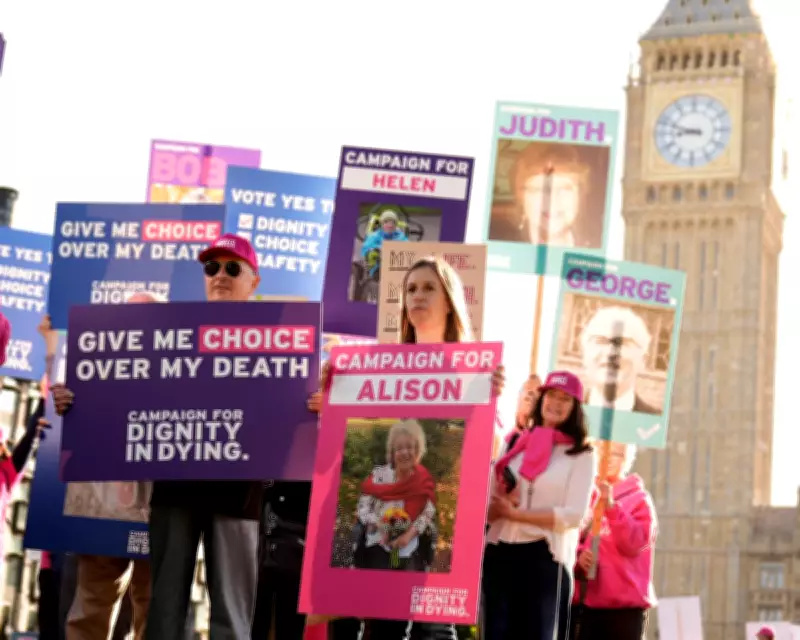
Protesters gathered outside the Houses of Parliament in London this week, demonstrating in support of assisted dying legislation as a dramatic parliamentary confrontation looms. Campaigners have vowed to deploy an extraordinary constitutional mechanism if the bill continues to face obstruction in the upper chamber.
The Nuclear Option: Invoking the 1911 Parliament Act
Supporters of the assisted dying bill are preparing to force it through using an archaic parliamentary procedure if the House of Lords persists in blocking its progress. This high-stakes move, described by some backers as the "nuclear option," would mark the first time the 1911 Parliament Act has been invoked for a private member's bill.
The acknowledgment that supporters are now seriously considering using the act signals growing desperation among campaigners. They have accepted that without a radical change of approach, the bill will fail due to the extensive delays it is experiencing in the House of Lords. If the legislation does not conclude by the end of the parliamentary session in May, it will automatically fail despite having been passed by the Commons.

Legal and Constitutional Battle Lines Drawn
The bill's principal backers, MP Kim Leadbeater and Lord Charles Falconer, have revealed they possess extensive legal and constitutional advice proving they can force peers to vote on the bill, unamended, in the next parliamentary session. This represents a significant escalation of hostilities between supporters and opponents of assisted dying legislation.
Lord Falconer emphasised that both the public and the Commons demand a proper parliamentary decision on this critical issue. "If opponents think this issue will just go away if it is talked out in the Lords then they are wrong," he stated. "It will continue to demand parliamentary action until it is resolved."
Falconer expressed hope that the Lords would change their approach to allow the bill to proceed to a vote. However, he noted that because the Lords operates as a self-regulating chamber, there exists no mechanism to prevent a small minority of peers from frustrating the will of the majority who wish to see the bill progress through all its stages.
Historical Precedents and Parliamentary Mechanics
The Parliament Act enables the House of Commons to reintroduce legislation and force it through if the Lords repeatedly blocks it. Since its revision in 1949, this mechanism has been employed for just a handful of bills to enact laws without the Lords' consent, including measures to decriminalise homosexuality and ban foxhunting.
After the current parliamentary session concludes, the bill must be reintroduced and passed again in the new session to trigger the act's override mechanism. Crucially, it must be exactly the same version of the bill as originally passed by the Commons.
There are two primary methods to invoke the Parliament Act: either through a supporter adopting the bill at the next private member's bill ballot, or by the government allocating parliamentary time for the bill to return to the Commons. Constitutional experts suggest the government could remain formally neutral while still facilitating this process.
Political Pressures and Opposition Concerns
For Number 10 to allocate even limited time to the bill in the next session would likely provoke significant outcry from opposing MPs, including cabinet ministers such as Wes Streeting and Shabana Mahmood, who are high-profile opponents of assisted dying legislation.
MPs supporting the bill are expected to begin applying pressure on party leaders, including Prime Minister Keir Starmer, to adopt this approach. They warn that if the bill falls due to the actions of unelected peers, political leaders would face substantial public backlash and risk appearing impotent on a matter of significant public concern.
However, invoking the Parliament Act is likely to spark fury among the bill's opponents, who will interpret it as tacit admission that Starmer was never truly neutral, given his previous support for reforming assisted dying laws.

Legislative Gridlock in the House of Lords
Peers are scheduled to begin their tenth day of debate on the bill, with hundreds of amendments still requiring consideration out of more than 1,200 that have been tabled. Remarkably, of the 59 clauses in the legislation, peers have not yet concluded debate on the very first clause.
According to analysis by the Hansard Society, the bill likely requires at least sixteen more sitting days merely to reach the end of committee stage, yet has less than half that time available before the parliamentary session concludes.
Last week, MPs and peers supporting the bill angrily accused a small group of Conservative and cross-bench peers of deliberately filibustering with repetitive speeches and pointless amendments designed to delay proceedings.
Criticisms and Counterarguments
Critics of the legislation argue that the bill contains fundamental flaws and lacks adequate safeguards. They note that it does not enjoy support from any of the royal medical colleges and claim that ministers and sponsors have been unable to answer even basic questions about its implementation at the dispatch box, contributing significantly to the delays.
A source close to Kim Leadbeater expressed confidence that the Parliament Act would apply if the bill were taken through Parliament a second time. They pointed to precedents where governments have allocated time for bills concerning matters of conscience, suggesting this could provide a pathway forward.
Despite Starmer's longstanding personal support for changes to assisted dying laws, scepticism persists among strategists in Downing Street. Some view the issue as an unnecessary distraction and a potentially risky electoral matter, contributing to the Prime Minister's reluctance to personally intervene or formally adopt the bill, despite having voted twice in favour of its passage.
As the parliamentary clock ticks down, this constitutional confrontation represents one of the most significant tests of parliamentary procedure in recent years, with profound implications for end-of-life legislation and the balance of power between the Commons and Lords.