

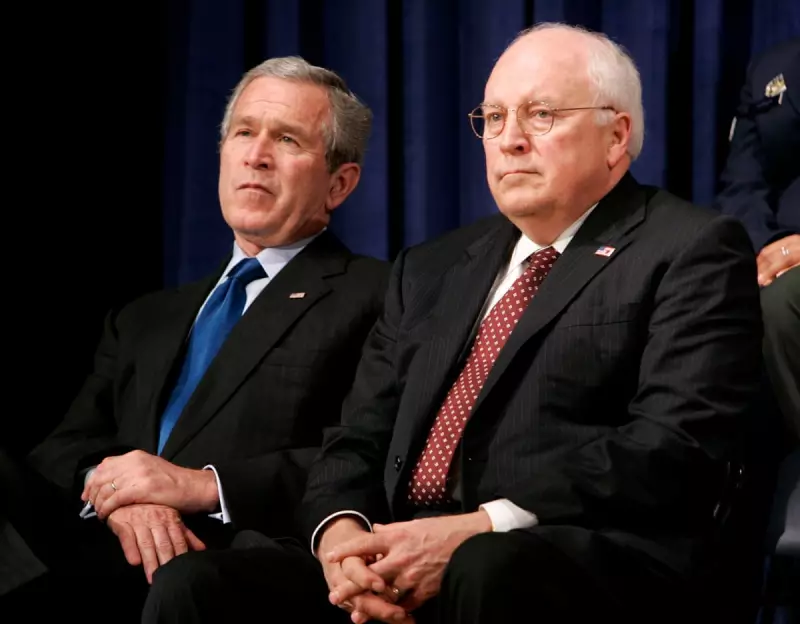
The death of Dick Cheney at 84 marks not just the passing of one of America's most influential vice-presidents, but the end of an era that fundamentally reshaped the American presidency. While Cheney spent his final years criticising Donald Trump as a threat to democracy, his own political legacy arguably laid the groundwork for Trump's assertive use of executive power.
The Unitary Executive Theory: Cheney's Lasting Legacy
Cheney, who served under George W Bush from 2001-2009, was a staunch proponent of what became known as the unitary executive theory. This controversial doctrine asserts that the president should exercise complete personal control over the entire executive branch, effectively placing millions of federal employees under direct presidential authority.
His commitment to expanding presidential power stemmed from his early political experiences. As a young chief of staff in Gerald Ford's administration, Cheney witnessed the aftermath of the Watergate scandal and concluded that Congress had overcorrected, leaving the presidency dangerously weakened.

"Dick Cheney is the godfather of the Trump presidency," according to Larry Jacobs, director of the Center for the Study of Politics and Governance at the University of Minnesota. "Trump is unchained because Dick Cheney had been at war for half a century against the restraints put in place after Vietnam and Watergate."
9/11 as a Turning Point for Executive Power
The terrorist attacks of September 11, 2001 provided the perfect environment for Cheney to implement his vision of expanded executive authority. In the climate of fear following the deaths of nearly 3,000 people, extraordinary measures became politically acceptable.
Cheney championed several controversial initiatives during this period:
- The Patriot Act, which granted sweeping surveillance powers
- Warrantless wiretapping programmes targeting suspected terrorists
- The creation of legal categories like "enemy combatant"
- Enhanced interrogation techniques through the "torture memos"
These policies established precedents that the Trump administration would later adapt for different purposes. The same legal justifications used for targeting terrorist suspects are now being employed to justify military actions against drug cartels and immigration enforcement.
The Irony of Cheney's Trump Opposition
In a striking historical twist, Cheney became one of Trump's most vocal Republican critics during his final years. He argued that Trump's actions went "well beyond their due bounds," particularly regarding election integrity. His daughter Liz Cheney emerged as one of Trump's most prominent Republican opponents, eventually losing her House seat over her stance.
This opposition highlights what experts see as a crucial distinction between Cheney and Trump. While both sought to expand presidential power, their motivations differed significantly.
"Cheney was trying to enhance the power of the presidency for policy and security reasons, while Donald Trump seems to be pushing for greater power that also has a personal dimension for him," noted Robert Schmuhl, professor emeritus of American studies at the University of Notre Dame.
Jake Bernstein, co-author of a book on Cheney's presidency, elaborated: "Cheney understood the balance between Congress and the executive was based on norms that could be stretched, but he was absolutely at heart an institutionalist. He didn't want to destroy those institutions."
The Lasting Impact on American Democracy
The expansion of executive power that Cheney championed has continued under successive administrations, regardless of political affiliation. Both Barack Obama and Joe Biden have maintained broad presidential authorities, unwilling to surrender powers once gained.
The ultimate battle over the unitary executive theory is now being waged in the Supreme Court, where recent rulings from the conservative majority suggest a shift away from precedents that have limited presidential authority for nearly a century.

As Jeremy Varon, a history professor at the New School for Social Research, observed: "The great irony is that Trump represents the repudiation of neocons like Cheney, but now America First is being weaponised, making use of 'war on terror' powers to capture, brutalise, dehumanise and kill people without legal constraint."
The story of Dick Cheney's political legacy serves as a powerful reminder that efforts to reshape government institutions often have consequences far beyond what their architects intended or desired.





