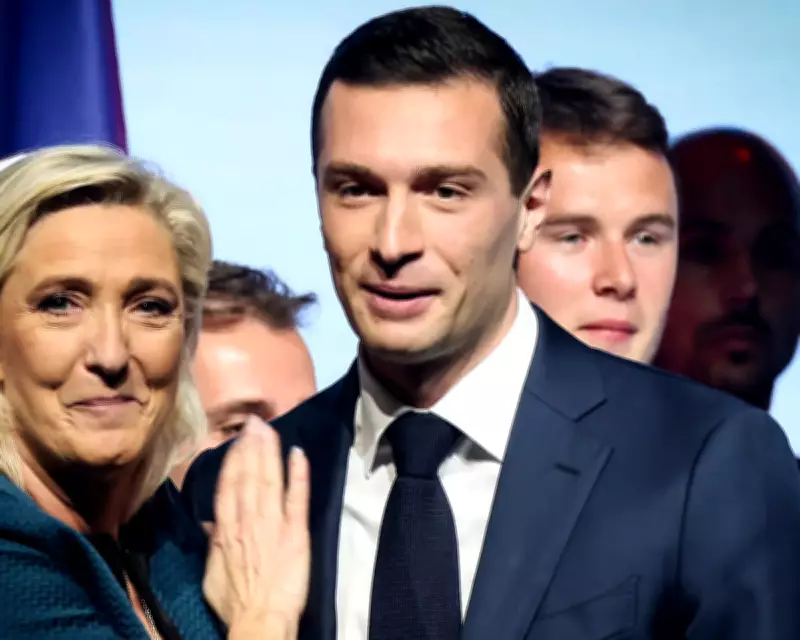
France's 2027 Election: Can Anyone Stop Jordan Bardella and the Far Right?
The race for France's 2027 presidential election is heating up, with the far-right National Rally (RN) holding a commanding lead in early opinion polls. Jordan Bardella, the party's 30-year-old president, is polling as high as 38% in first-round voting intentions, positioning him as a formidable contender for the Élysée Palace. His patron, Marine Le Pen, remains ineligible unless an appeals court overturns her sentence for embezzlement of EU funds in July.
A Crowded Field Risks Splitting the Anti-RN Vote
The central challenge for France's political establishment is finding a single candidate capable of uniting the moderate right, centre, and moderate left to defeat Bardella in the run-off. However, the landscape is fragmented, with multiple contenders vying for attention. The left is deeply divided, with radical France Unbowed leader Jean-Luc Mélenchon, 74, likely to make a third presidential run despite accusations of antisemitism and associations with militant groups. Polls suggest Mélenchon could siphon enough votes to block other left-wing candidates but would lose decisively to Bardella in a run-off.
On the centre left, potential candidates include Raphaël Glucksmann, 46, who appeals to urban professionals but struggles with working-class voters, and former president François Hollande, 71, whose unpopular tenure from 2012-2017 remains a significant handicap. The centre right sees former prime minister Edouard Philippe, 55, as an early frontrunner, with some polls indicating he could narrowly beat Bardella. However, Philippe has opted to bide his time, delaying national campaigning until after the summer.

Other Contenders and the Perils of Fragmentation
Other figures are also eyeing the presidency. Gabriel Attal, 37, leader of the centrist Renaissance party, is preparing a bid that could split Macron's camp. Bruno Retailleau, 65, of Les Republicains, has thrown his hat in the ring, advocating for strict law and order policies, but faces internal rivalry from Laurent Wauquiez, 51. Wauquiez has proposed a primary to unite candidates from the centre to the far right, excluding the RN, but the idea has gained little traction.
Elder statesmen like Dominique de Villepin, 72, and Thierry Breton, 71, are also positioning themselves as potential "hommes providentiels" or providential outsiders. De Villepin, known for opposing the US invasion of Iraq in 2003, has launched a micro-party called Humanist France. Breton, a former EU commissioner, brings tech and defence expertise but lacks a political machine.
Anti-Establishment Sentiment and the Path Forward
The French political mood is dominated by anti-establishment sentiment, exacerbated by economic pressures like inflation from the Iran war. This environment favors outsiders, making it risky for early frontrunners like Philippe. The more candidates that enter the first round without unifying behind a single anti-RN champion, the higher the likelihood that Bardella will secure victory. The coming year will be a marathon battle to determine whether France's fragmented opposition can coalesce in time to prevent a far-right presidency.