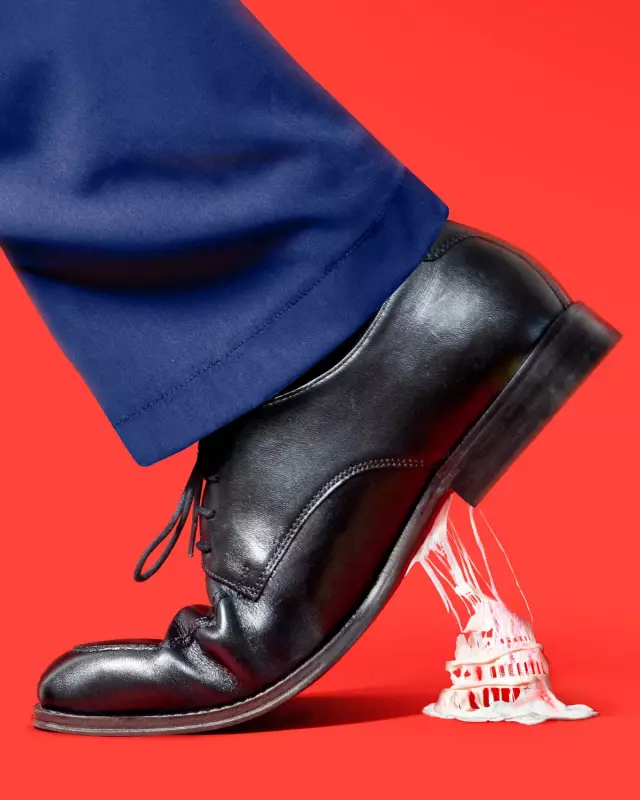
In the frigid January of 2025, Donald Trump's second inauguration was held within the US Capitol rotunda, a symbolic heart of legislative power. Yet, almost immediately after leaving the building, the President embarked on a systematic campaign to sideline that very branch of government, according to governance experts.
An Unprecedented Assault on Institutional Norms
Molly Reynolds, director of governance studies at the non-partisan Brookings Institution, stated that the past year has seen a significant escalation in executive intrusion into congressional authority. "We've seen new and different ways that the executive branch has tried to intrude into congressional power," Reynolds said, noting a failure by congressional Republicans to mount a robust defence of their institution.
At President Trump's direction, the leaders of several independent agencies—including the National Labor Relations Board, the Merit Systems Protection Board, and the Federal Trade Commission—were fired. These officials had been Senate-confirmed for roles designed to span presidential administrations. Later in 2025, Trump also attempted to fire a Federal Reserve governor and opened a criminal investigation into Chair Jerome Powell over interest rate policy disputes.
David Mayhew, a professor emeritus at Yale University, labelled this assault on independent agencies as the President's "most disturbing behaviour," calling it a violation of statute, norms, and potentially the constitution itself.
Bypassing Congress on Spending, War, and Trade
The administration's methods of circumventing legislative oversight have been varied and bold. President Trump has refused to spend funds specifically appropriated by Congress and has repeatedly invoked emergency powers to impose wide-ranging tariffs on US trading partners.
Perhaps most starkly, he ordered a military raid to capture Venezuela's president, Nicolás Maduro, without seeking permission from or giving advance notice to Congress. This move prompted fierce criticism from Democrats, with former House Speaker Nancy Pelosi accusing Republicans of having "abolished the Congress of the United States."
Furthermore, Trump has pursued a concerted effort to thin the federal workforce through layoffs and has ordered the dismantling of the congressionally created Department of Education, seeking to parcel out its functions—a move experts like Mayhew argue he lacks clear authority to make.
Limited Pushback and a Fragile Legislative Balance
Despite holding majorities in both the House and Senate, Republican lawmakers have largely acquiesced to the President's power grabs. Philip Wallach of the American Enterprise Institute explained that decades of accumulated presidential power, enabled by both parties, have now been unleashed by a leader with "very little respect" for the norms that once restrained its use.
When dissent has emerged, leadership has acted decisively to quash it. House Speaker Mike Johnson changed chamber rules to block a resolution aiming to overturn Trump's tariffs. In the Senate, a war powers resolution to prevent future attacks on Venezuela without congressional consultation initially gained traction with five Republican defectors, but died after sustained White House pressure.
However, Trump's control is not absolute. A bipartisan coalition in the House forced through a measure extending Affordable Care Act tax credits, and another group passed the Epstein Transparency Act, which the President later signed into law. Democratic Representative Ro Khanna called the latter "a turning point" where Congress saw it could stand up to the president and win.
As legal challenges to many of these policies head towards a conservative-majority Supreme Court, the long-term damage to the balance of power remains a grave concern. Democratic Representative Jamie Raskin warned that "it's very hard to regather presidential powers gone wild," but expressed hope that future presidents would show more respect for the rule of law than Donald Trump.