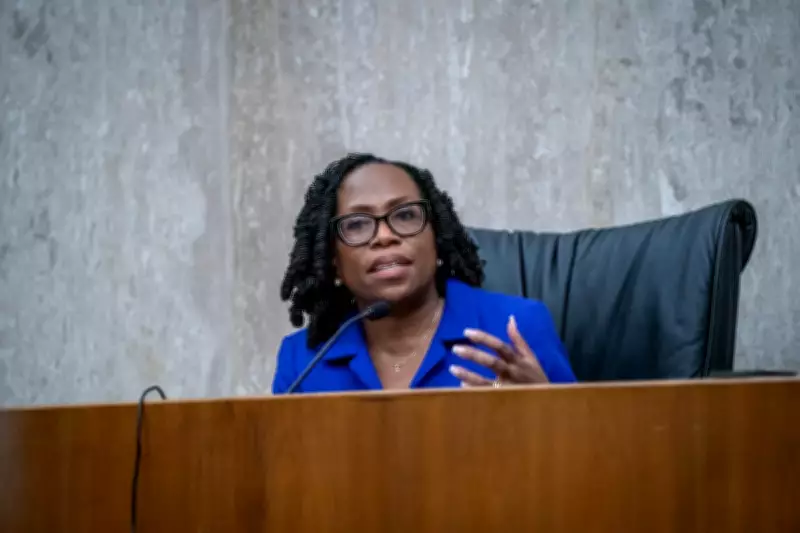
Justice Jackson Delivers Scathing Critique of Conservative Justices' Emergency Rulings
In a powerful address at Yale Law School, Supreme Court Justice Ketanji Brown Jackson launched a sustained attack on her conservative colleagues' use of emergency orders to benefit the Trump administration. She condemned these rulings as "scratch-paper musings" that can "seem oblivious and thus ring hollow," highlighting a deep divide within the nation's highest court.
Emergency Docket Under Fire
Jackson focused on roughly two dozen court orders issued last year that allowed former President Donald Trump to implement controversial policies on immigration and federal funding cuts, despite lower courts finding them likely illegal. While designed as short-term measures, these orders have enabled Trump to advance key parts of his conservative agenda, at least temporarily.
The emergency docket involves appeals in ongoing lower court cases where the Supreme Court intervenes swiftly without oral arguments. During Trump's first term, his administration filed 34 emergency applications, with the court siding with him in most instances, according to reports.

A Shift in Judicial Restraint
Jackson noted that the court historically hesitated to intervene early in legal processes, valuing restraint on divisive policy issues. However, she observed a recent change: "In recent years, the Supreme Court has taken a decidedly different approach to addressing emergency stay applications. It has been noticeably less restrained, especially with respect to pending cases that involve controversial matters."
She argued that these orders, often issued with minimal explanation, are treated as "back-of-the-envelope, first-blush impressions" yet are enforced by lower courts in other cases. Jackson emphasized that this approach fails to acknowledge the real people affected, making the rulings appear detached and ineffective.
Political Dynamics and Public Statements
Trump's appointment of three justices during his first term shifted the court's balance to six conservatives out of nine members. President Joe Biden nominated Jackson in 2022 to replace retiring Justice Stephen Breyer, maintaining the liberal bloc at three justices. Jackson has previously criticized emergency orders in dissents and in a rare joint appearance with Justice Brett Kavanaugh, but her Yale speech marked a notable public appeal for reform.
She expressed hope that her comments could serve as "a catalyst for change," acknowledging internal discussions among justices but opting for a public platform to drive awareness.
Sotomayor's Apology and Court Decorum
In a related development, Justice Sonia Sotomayor issued a rare public apology for remarks made about Kavanaugh last week at the University of Kansas School of Law. She had criticized him in terms referencing his family, stating, "This is from a man whose parents were professionals. And probably doesn't really know any person who works by the hour," in response to his opinion on immigration stops.
Sotomayor apologized, saying, "I made remarks that were inappropriate. I regret my hurtful comments. I have apologized to my colleague." This incident underscores the court's unwritten rule against personal attacks on families, contrasting with former President Trump's public criticisms of justices he nominated.
Jackson's critique and Sotomayor's apology highlight ongoing tensions within the Supreme Court as it navigates high-stakes legal and political battles, with emergency orders becoming a focal point for debates over judicial integrity and fairness.