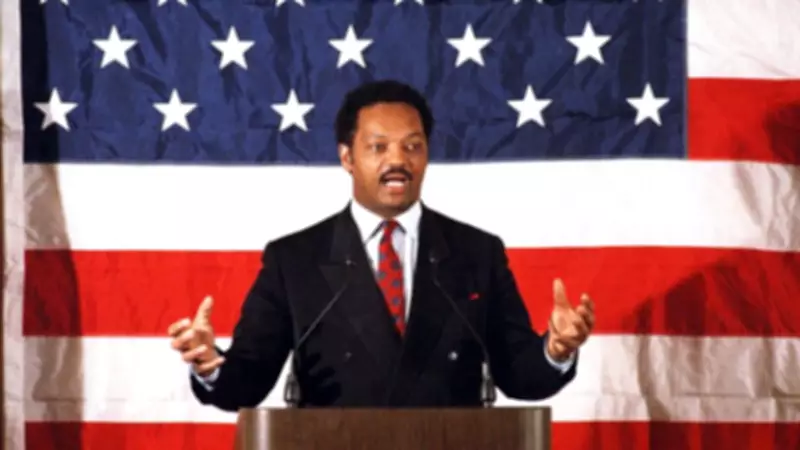
Jesse Jackson: The Civil Rights Activist Who Sowed Seeds of Possibility
Jesse Jackson, a towering figure in the American civil rights movement and a protege of Martin Luther King Jr., passed away, leaving behind a legacy of activism and political ambition. He campaigned twice for the Democratic presidential nomination, famously urging Americans to "Keep hope alive" in his 1988 convention speech. Born in 1941 in Greenville, South Carolina, Jackson grew up under Jim Crow laws and rose to prominence as a voice for the voiceless, advocating for racial justice and equality.
From Segregation to National Prominence
Jackson's early life was marked by the brutal realities of segregation in the South. He earned a football scholarship to the University of Illinois but transferred to a historically black college due to discrimination. His activism began as a student, including an arrest for attempting to enter a "whites-only" library. Ordained as a Baptist minister in 1968, he caught the attention of Martin Luther King Jr., becoming his protege and was present at King's assassination in Memphis.
In the 1970s, Jackson founded Operation PUSH in Chicago, later merging it with the National Rainbow Coalition in 1996 to form the Rainbow/PUSH Coalition. This organization championed not only black rights but also advocated for women and gay communities, expanding his influence across diverse groups.

Presidential Campaigns and Political Impact
Jackson ran for the Democratic presidential nomination in 1984 and 1988, attracting black voters and white liberals with his impassioned oratory. In his 1984 speech, he declared, "My constituency is the desperate, the damned, the disinherited, the disrespected, and the despised," encapsulating his focus on social justice. Although he never secured the nomination, his campaigns blazed a trail, setting the stage for Barack Obama's historic election 20 years later.
Beyond his runs, Jackson served as a special envoy to Africa under President Bill Clinton, helping secure the release of Americans held overseas. He also pushed for cultural shifts, such as promoting the term "African American" in the late 1980s, and received the Presidential Medal of Freedom in 2000.
Controversies and Personal Life
Jackson's career was not without controversy. In 1984, he faced allegations of using a slur against Jewish people, later apologizing at a synagogue. His personal life included marriage to Jacqueline Brown in 1962, with whom he had five children, and a daughter born out of wedlock in 1999, whom he supported financially and emotionally. In 2008, he made headlines for criticizing Barack Obama but later celebrated his election with tears of joy.
Later Years and Legacy
In his final years, Jackson continued to protest racial injustice, condemning events like the police killing of George Floyd. Diagnosed with Parkinson's disease in 2017 and later with progressive supranuclear palsy, he remained active until his death. Tributes have highlighted his role in redefining possibilities for minorities and the poor. As he told the Associated Press, "Part of my job was to sow seeds of the possibilities," a testament to his enduring impact on American society.