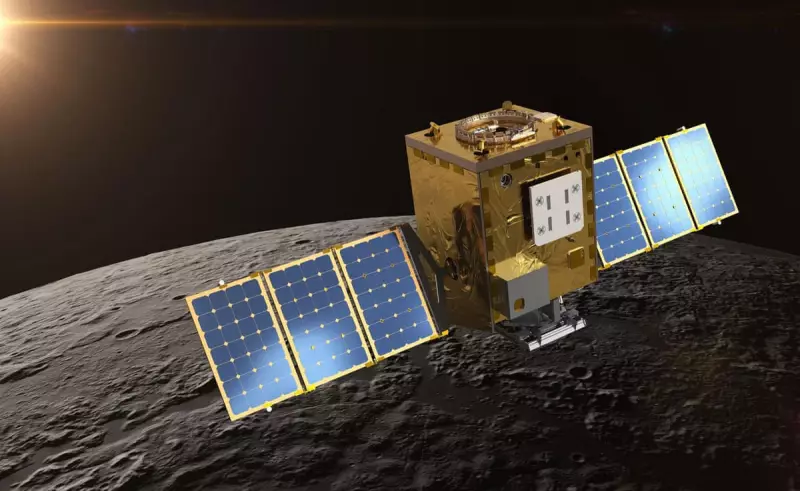
With a surge in lunar exploration on the horizon, scientists are urgently planning for an unusual consequence: where to dump the resulting space junk. Researchers warn that specific patches of the moon are destined to become spacecraft graveyards, where defunct satellites and hardware will be deliberately crash-landed to protect sites of cultural and scientific importance.
The Looming Lunar Traffic Jam
The number of satellites orbiting the moon is set to skyrocket over the next two decades. This increase is driven by ambitious plans from space agencies and private companies to establish moon bases, conduct mining operations, and build scientific instruments on the barren terrain. This activity will be supported by constellations of lunar satellites providing essential positioning, navigation, and communications services.
However, when these satellites reach the end of their operational lives and run out of fuel, operators face a unique problem. Unlike around Earth, where old satellites can be incinerated in the atmosphere, the moon has no atmosphere for disposal. The most feasible option often becomes steering them into a controlled crash onto the lunar surface.
Dr Fionagh Thomson, a senior research fellow at Durham University, highlighted the issue at the Space-Comm meeting in Glasgow last December. "These satellites will have to be crash-landed on the moon, so it will potentially become a rubbish site," she stated, emphasising the need for proactive management.
Risks of an Uncontrolled Downpour
Experts fear that without a coordinated plan, raining satellite debris poses significant risks. Impacts at speeds of 1.2 miles per second could damage future lunar bases, scientific instruments, and historic sites like the first astronaut footprints. The collisions would produce intense vibrations, potentially disrupting sensitive equipment, and carve scars tens of metres long.
Furthermore, the impacts would kick up vast, abrasive clouds of lunar dust that could obscure telescopes and damage other surface assets. Professor Ian Crawford of Birkbeck, University of London, noted that while the moon's vast surface area mitigates immediate concern, the probability of damage grows with each new mission. "We do need a plan going forward," he urged.
The scale of the challenge is underscored by the sheer volume of planned activity. More than 400 moon missions are planned in the next 20 years, including NASA's Lunar Gateway station, the Artemis base camp, and a separate base planned by China and Russia. The European Space Agency's Moonlight constellation is slated to be operational by 2030, starting with the Lunar Pathfinder test satellite next year.
Designated Drop Zones: The Proposed Solution
The leading solution, gaining international traction, is the establishment of official lunar spacecraft graveyards. This would require operators to crash their defunct hardware into designated, uninhabited zones or giant craters that could contain the resulting dust plumes.
Sarah Boyall, head of the Office of Regulation at the UK Space Agency, confirmed that the UN's Action Team on Lunar Activities Consultation (ATLAC) and the Inter-Agency Space Debris Coordination Committee (IADC), currently chaired by the UK, are working to establish best practices. This approach is also supported by signatories to the US Artemis Accords.
"Establishing graveyard zones on the moon is the most practical solution," said Ben Hooper, senior project manager for Lunar Pathfinder at Surrey-based SSTL. "Designating specific regions as 'impact zones' would limit the spread of human artefacts... preserving other areas for scientific exploration."
Charles Cranstoun, head of the ESA's Moonlight programme, assured that future disposals would be controlled crashes "in specified zones," deliberately avoiding sites of interest. Interestingly, Professor John Zarnecki of the Open University suggested a silver lining: these planned impacts could generate valuable seismic data, acting as "a fantastic experiment in seismometry" to probe the moon's internal structure.
As the new space race accelerates, the focus is expanding from merely reaching the moon to sustainably managing humanity's growing footprint on its ancient surface.