Meloni's Strategic Pivot: How Italy's PM is Distancing Herself from Trump
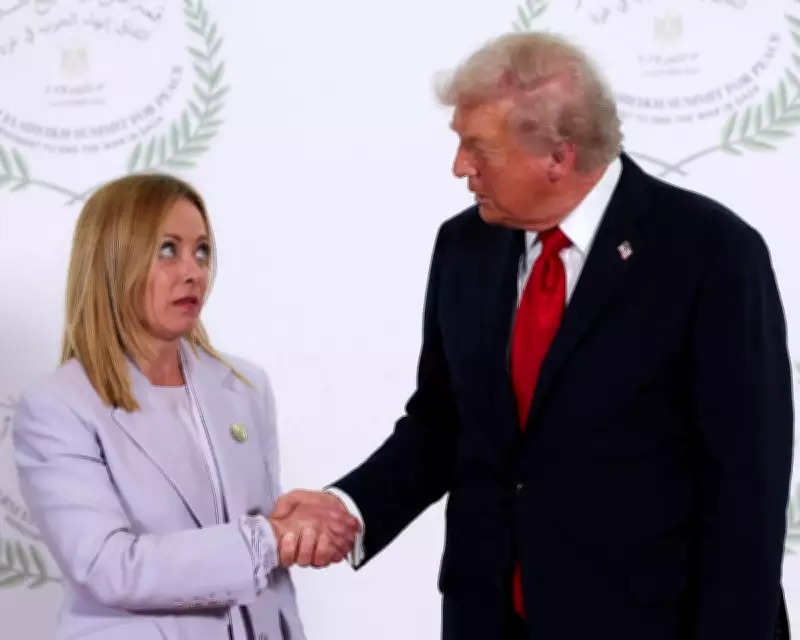
Six months ago, Italy's far-right Prime Minister Giorgia Meloni stood on a stage in Sharm el-Sheikh, Egypt, where world leaders had gathered to discuss the Gaza peace deal. In front of her, Donald Trump showered praise and insults on assembled leaders before turning to Meloni with a remark that would become symbolic of their relationship. "You don't mind being called beautiful, right? Because you are," Trump said, putting Meloni in an uncomfortable position that she accepted with diplomatic grace.
A Relationship Built on Nationalistic Rhetoric
Meloni had worked diligently to establish herself as a solid European ally for Trump, paying a flying visit to his Mar-a-Lago country club in Florida and being the only European leader to attend his inauguration as US president. This relationship, rooted in shared nationalistic rhetoric and political alignment, appeared strong and mutually beneficial during their initial interactions.
However, that carefully cultivated relationship is now unraveling as quickly as it formed. In a recent interview with the Italian newspaper Corriere della Sera, Trump turned on Meloni, accusing her of "lacking courage" for failing to join the US-Israeli war on Iran. This rebuke came after Meloni described Trump's attack on Pope Leo – who has emerged as a vocal critic of the Iran war – as "unacceptable."

The Turning Point in US-Italy Relations
"She is the one who is unacceptable," Trump snapped in response, "because she doesn't care if Iran has a nuclear weapon and would blow up Italy in two minutes if it had the chance." These remarks represent a significant deterioration in what was once considered a cosy political relationship between the Italian prime minister and the former US president.
The comments rounded off a challenging month for Meloni, whose government suffered a bruising setback in a referendum on a judicial overhaul in March. Her previously warm relations with Trump have become an increasing political liability in a country with a deeply rooted anti-war culture and growing concerns about international conflicts affecting domestic stability.
Political Calculations and Strategic Distancing
According to political analysts, Meloni needed a way to help restore her image and recuperate consensus – and Trump's feud with Pope Leo provided the ideal opportunity. "When you consider the moment in Sharm-el Sheikh, she wasn't pleased to receive that compliment – she understood how diminishing it was – but she accepted it," said Cecilia Sottilotta, an associate politics professor at the University for Foreigners in Perugia.
"However, there comes a time when never standing up to your partner becomes a problem. So the Pope Leo row was welcome news for Meloni, because in Italy, people love their popes, and they hate wars. Meloni desperately needed an excuse to distance herself from Trump and this was a good one."
Delicate Balancing Act in Foreign Policy
Meloni had started to distance herself from Trump after the strikes in Iran were launched in late February, albeit cautiously. In parliament, she strongly criticised the conflict while simultaneously warning that "we cannot afford a regime of ayatollahs in possession of nuclear weapons" that could threaten Italy and Europe.
After the referendum defeat, she adopted a stronger approach by denying use of an airbase in Sicily for US military planes carrying weapons for the Iran war. Still, her delicate balancing act was visible even with her defence of Pope Leo. Meloni said Trump's verbal attack against the pontiff – whom he described as "weak" and catering to the "radical left" – was "unacceptable," but only after she came under pressure from the opposition when she omitted to address the remarks in a social media post.
Election Strategy and Domestic Priorities
Now beginning to focus on general elections in 2027 – which until the referendum were expected to strongly favour her ruling coalition – Meloni has begun a tactful pivot. In a further sign of distancing herself from the war, this week Italy suspended a defence pact with Israel, previously a staunchly supported ally.

Meloni also reiterated her government's backing of Ukraine during a meeting with Ukrainian President Volodymyr Zelenskyy in Rome, pledging to help boost the country's defences against Russian attacks. On Friday, she will join French President Emmanuel Macron and British Prime Minister Keir Starmer – who have also been repeated targets of Trump's wrath – for talks in Paris on securing the Strait of Hormuz.
Political Landscape and Future Prospects
Although Meloni's Brothers of Italy has lost some support in recent weeks, the party maintains a lead in polls, as does Meloni's personal popularity rating even if her leadership has lost some of its initial shine. Unless the fragmented opposition produces a credible alternative to Meloni, the polls are likely to remain static.
Her government is now expected to prioritise plans to pass an electoral law that could give it a comfortable win in the next elections. "I believe the coalition remains favoured, in the sense that it has a clear leader," said Lorenzo Pregliasco, a co-founder of YouTrend, a political analysis firm. "The opposition still needs to define the alternative."
Domestic Challenges and International Positioning
Meloni's government has enjoyed a relatively stable ride since coming to power in October 2022, mostly due to its compact nature rather than achieving anything particularly meaningful to improve the lives of Italians. "She's dealt with the Trump issue, which in the short term, was a tactful move," said Mattia Diletti, a politics professor at Sapienza University in Rome.
"But unless she makes some spectacular changes on the domestic front, she will decline. Italians don't care too much about international politics but they do care about the war in Iran and wider Middle East, because it's affecting their lives and the cost of living, so the sooner it stops, the better for Meloni."
The ousting of her far-right ally Viktor Orbán in Hungary in recent elections is also suspected to have played a role in Meloni's reaction to Trump – especially after US Vice-President JD Vance travelled to Budapest in an effort to boost Orbán's chances. "Vance going to Orbán was like delivering the kiss of death," said Sottilotta. "So when she saw that, she really understood the political dynamics at play."