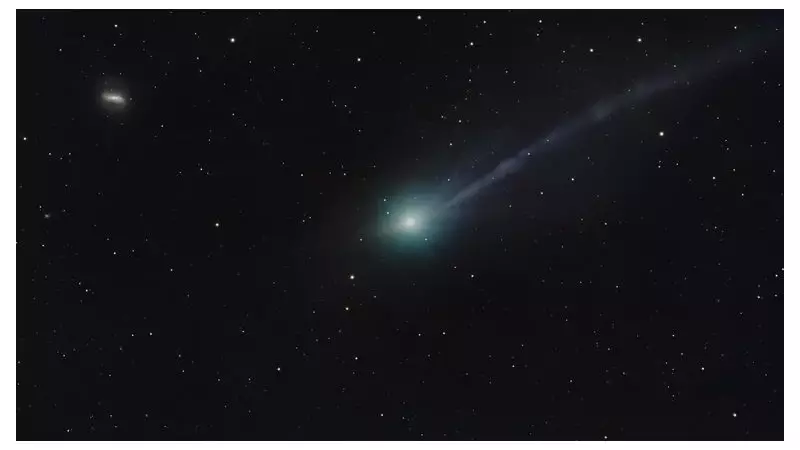
A mysterious object from deep space, which has ignited a fierce scientific debate about its true nature, is set to make its closest approach to Earth on Friday. The interstellar visitor, known as 3i/ATLAS, will race past our planet at a staggering 130,000 miles per hour, though it poses no threat as it will remain at a safe distance of roughly 170 million miles – about twice as far from us as the Sun.
The Great Scientific Divide: Comet or Craft?
While the vast majority of astronomers, including teams from NASA and the European Space Agency, are in firm agreement that the object is a comet, a prominent Harvard University astrophysicist has stirred controversy. Professor Avi Loeb has publicly stated that he cannot dismiss the possibility that extraterrestrial technology might be involved, warning humanity to be on high alert.
"When there are implications to society, we must consider even an unlikely event and collect as much data as possible to convince us otherwise," Professor Loeb told Sky News. He described a potential encounter with alien technology as a "black swan event" – highly improbable but with monumental consequences. He pointed to several unusual features, including an atypical tail that could suggest propulsion, the presence of nickel in its gas cloud, and a trajectory aligned with our solar system's planets that seems too coincidental.

NASA's Firm Rebuttal and the Comet's Epic Journey
In stark contrast, space agencies have mobilised a dozen spacecraft cameras to study 3i/ATLAS and are unequivocal in their assessment. Amit Kshatriya from NASA stated plainly: "This object is a comet. It looks and behaves like a comet. All evidence points to it being a comet."
The object's journey has been tracked since it was first spotted as a distant speck of light in July 2025. It moved rapidly through our solar system, passing Mars in early October, briefly vanishing behind the Sun, and will now swing by Jupiter before fading from view. Scientists estimate this cosmic traveller is an astonishing eight billion years old – twice the age of our Sun – making it a fossil from the formation of another star.
A Clash of Scientific Philosophies
The debate has exposed a deep rift in scientific approach. Professor Chris Lintott, an astronomer from the University of Oxford, dismissed the alien technology theory as "just nonsense," comparing it to speculating the Moon is made of cheese. He argues every observed characteristic, from its changing colour to its brightness, can be explained by solar heating of its icy components.
However, Professor Loeb accuses the scientific establishment of arrogance, stating: "At the foundation of science is the humility to learn... They're not willing to learn something new." This is not the first time Loeb has made such claims; he proposed similar theories about ‘Oumuamua, another interstellar visitor, in 2017.
As 3i/ATLAS completes its flyby, the core facts remain: an ancient, natural comet is passing at a great distance. Yet, the passionate debate it has triggered about how we explore the unknown and confront extraordinary ideas continues to resonate far beyond the realm of astronomy.