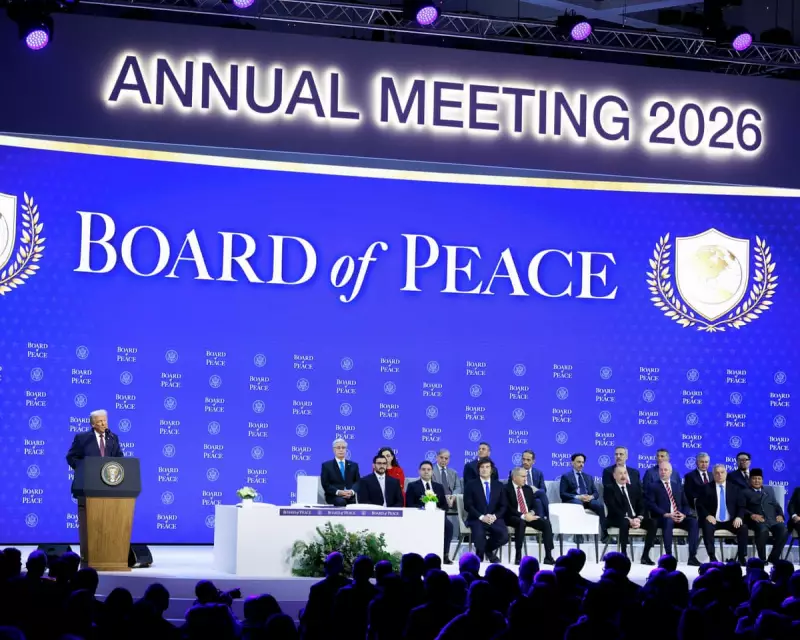
The formal launch of Donald Trump's Board of Peace in Davos on Thursday has sparked intense scrutiny, with its charter revealing a body less focused on 'America First' and more on 'Trump Always'. This initiative, ostensibly created to oversee administration and reconstruction in Gaza, appears instead to function as an institutional expression of the former US president's personal authority, raising profound questions about its legitimacy and purpose.
A Charter of Personal Power
The board's founding document conspicuously omits any mention of Gaza, despite its origins in a UN Security Council resolution that authorised a peace-building body chaired by Trump for the region. Instead, the charter establishes Trump as permanent chair, granting him unilateral power to set the agenda, select his successor, and dismiss members at will—even those who have contributed the $1 billion required for permanent membership. This structure mirrors Trump's longstanding belief that he is bound not by law but by his own morality and mind, effectively creating a personal fiefdom under the guise of international cooperation.
Undermining Multilateral Institutions
Critics argue that the Board of Peace represents a deliberate attempt to encroach upon, if not supplant, the United Nations and other established multilateral bodies. Trump, increasingly fixated on landgrabs and personal legacy, now heads an 'international peace-building body' intended to replace what he deems 'failed' institutions. The involvement of figures like Tony Blair and Jared Kushner on the executive board, alongside regional officials on a Gaza committee, has relegated Palestinians to a fourth-tier technocratic role, further marginalising their voice in determining their own future.

The board's membership roster includes controversial leaders such as Benjamin Netanyahu—indicted by the International Criminal Court—alongside Belarus, Uzbekistan, and Hungary. While eight Muslim-majority states, including Saudi Arabia, Egypt, and Turkey, have joined, traditional US allies are notably absent. This selective participation underscores the board's divisive nature and its potential to fragment international efforts rather than unify them.
Gaza's Precarious Future
Amid the ongoing devastation in Gaza, where 2 million Palestinians endure a brutal winter amidst ruins and continuous Israeli bombardment, the board's launch offers a glimmer of procedural activity. Presentations by Palestinian and US officials outlined plans for the next 100 days, including proposals from Jared Kushner that may displease hardline Israelis seeking to displace Palestinians entirely. These plans advocate for increased aid, reopening the Rafah crossing, and repairing essential infrastructure—measures desperately needed but fraught with uncertainty regarding implementation and terms.
Trump's real-estate background and desire for acclaim as a peacemaker might incentivise his engagement, potentially reducing Netanyahu's influence. However, the rights of Palestinians risk being treated as an irrelevant detail in this calculus. With Trump's demonstrated contempt for international law, the burden falls on other nations to defend legal norms and ensure that Gaza's reconstruction does not become a tool for personal aggrandisement.
The Board of Peace, therefore, stands at a crossroads: it could either evolve into a serious mechanism for peace-building or remain a symbolic declaration of Trump's power, further complicating the already daunting task of achieving justice and stability in Gaza.