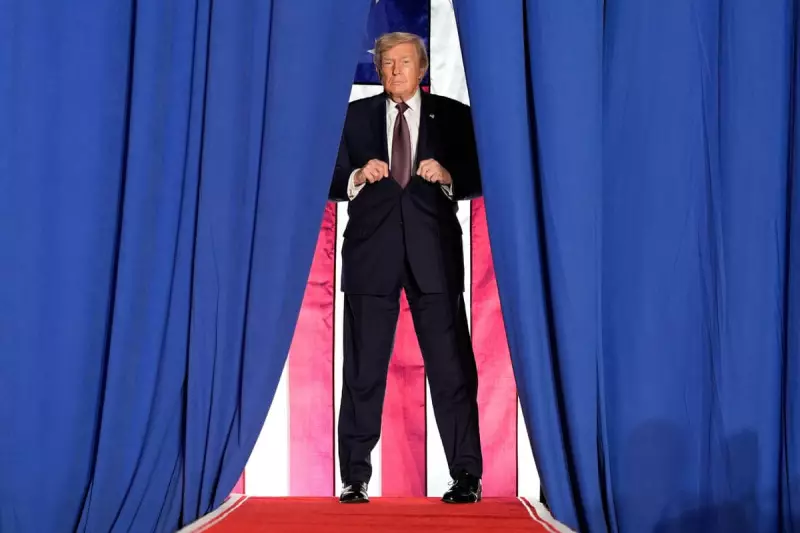
Throughout 2025, the behaviour of US President Donald Trump has come under intense scrutiny, with numerous incidents prompting questions about his mental and physical fitness for office. The 79-year-old's second term has been marked by a series of erratic public appearances, confused statements, and a notably reduced schedule, leading opponents and observers to question his acuity.
A Catalogue of Confusion and Bizarre Segues
The year provided a growing list of moments that forced the White House onto the defensive. In a mid-July address, Trump recounted a detailed but impossible story involving his late uncle, Professor John Trump, and the Unabomber, Ted Kaczynski. He claimed his uncle taught Kaczynski at MIT and discussed his student's character. The account was factually flawed on multiple levels: John Trump died in 1985, a decade before Kaczynski was publicly identified, and the Unabomber did not study at MIT.
Later that same month, during a high-level meeting with European Commission President Ursula von der Leyen, Trump abruptly pivoted from immigration policy to deliver a two-minute, unprompted rant against wind turbines. He asserted without evidence that they drive whales "loco" and kill birds, despite industry data showing turbines account for a tiny fraction of bird deaths compared to domestic cats or collisions with power lines.

Public Ramblings and Private Naps
Perhaps one of the most telling incidents occurred in September. While addressing the nation's top military commanders in Virginia, Trump diverged into an extended monologue about the perils of walking down stairs. He criticised President Joe Biden for allegedly falling and spent considerable time mimicking how his predecessor, Barack Obama, would "bop" down steps without holding on, declaring he had "zero respect for him as a president" despite this apparent stair-descending prowess.
Alongside these discursive speeches, Trump has been reported falling asleep during official meetings on multiple occasions. Witnesses noted him nodding off during an Oval Office meeting in November, a cabinet meeting in early December, and again at a press conference announcing cannabis reforms two weeks later. His public schedule has also diminished significantly; an analysis by the New York Times found his scheduled events now typically run from noon to 5pm, a shorter day than his first term, with a 39% decrease in official appearances.
White House Defence and Political Fallout
The White House has responded to growing concerns with fierce denials and personal attacks on the media. A spokesperson previously told the Guardian the president's "mental sharpness is second to none," while former White House physician Ronny Jackson, now a Republican congressman, proclaimed Trump the "healthiest president this nation has ever seen." In a statement to the Guardian, Assistant Press Secretary Liz Huston dismissed the reporting as "garbage" from a "left-wing mouthpiece," accusing the media of a double standard compared to its coverage of Biden.
Despite this defence, the political impact is becoming measurable. A Gallup poll in November found Trump's approval rating at 36%, the lowest of his second term. Furthermore, a YouGov survey earlier in the year indicated half of Americans believe he is too old to be president. Recognising this vulnerability, reports from the Daily Beast suggest Democratic strategists plan to make Trump's mental acuity and fitness a central issue in the upcoming midterm elections.
The controversy shows no sign of abating. With Trump set to turn 80 in June 2026, every mumbled aside, every strange tangent, and every moment of apparent fatigue will likely be magnified on the political stage, ensuring questions about the president's capacity remain at the forefront of American political discourse.