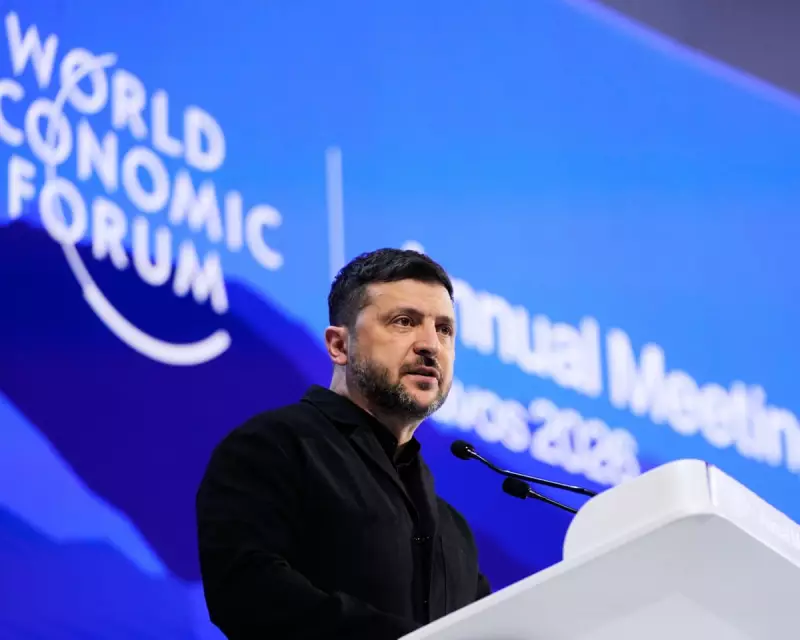
In a pointed address at the World Economic Forum in Davos, Ukrainian President Volodymyr Zelenskyy launched a stinging critique of European leadership, accusing the continent's politicians of operating in what he termed 'Greenland mode'. This phrase references the extraordinary demands by former US President Donald Trump for America to acquire Greenland, with Zelenskyy suggesting European leaders are similarly paralysed, awaiting direction from Washington rather than taking decisive action to bolster their own defence.
A Year Without Change
'Just last year, here in Davos, I ended my speech with the words Europe needs to know how to defend itself,' Zelenskyy reminded the audience. 'A year has passed, and nothing has changed.' His speech largely avoided direct criticism of Trump himself, instead focusing blame on European capitals for remaining at the behest of an increasingly unpredictable White House and failing to develop autonomous strategic capabilities.
Waiting for America to 'Cool Down'
Zelenskyy highlighted the geopolitical uncertainty, stating: 'Everyone gave attention to Greenland, and it is clear most leaders are not sure what to do about it. It seems like everyone is just waiting for America to cool down on this topic, hoping it will pass away. But what if it does not: what then?' He questioned the symbolic value of minimal troop deployments, asking what message sending '14 or 40 soldiers to Greenland' sends to adversaries like Vladimir Putin's Russia or to allies such as Denmark.

Ukraine's Offer and European Vulnerabilities
In a striking offer of assistance, Zelenskyy suggested Ukraine could help defend European interests, stating: 'We know what to do if Russian warships go near Greenland, Ukraine can help with that. They can sink near Greenland just as they do near Crimea.' He further urged Europe to play a more robust role in targeting Russia's 'shadow fleet' of oil tankers that help finance its war effort, criticising the ease with which Moscow bypasses sanctions to mass-produce missiles.
The Ukrainian leader framed the threats as existential for NATO, arguing that Europe desperately needs a 'united armed forces' capable of defending the continent independently. 'Today, Europe relies only on the belief that if danger comes, then NATO will react. But no one has really seen the alliance in action,' he warned, posing stark questions about potential Russian aggression against NATO members like Lithuania or Poland.
The Reliance on US Leadership
'Right now, NATO exists thanks to the belief that the United States will act ... but what if it doesn't?' Zelenskyy's speech underscored a core anxiety in European defence circles: the over-reliance on American military guarantees amidst shifting US political priorities. His remarks came shortly after a meeting with Donald Trump to discuss stalled peace talks for Ukraine, where Trump described the discussions as 'good' but acknowledged 'a ways to go'.
Trump's envoy, Steve Witkoff, accompanied by Jared Kushner, was scheduled to meet Vladimir Putin later that day, with Witkoff suggesting the Russian-called meeting was a positive sign. When asked at Davos for a message to Putin, Trump simply stated: 'The war has to end.' Zelenskyy's Davos intervention powerfully highlighted the urgent need for European strategic autonomy as global power dynamics continue to evolve unpredictably.