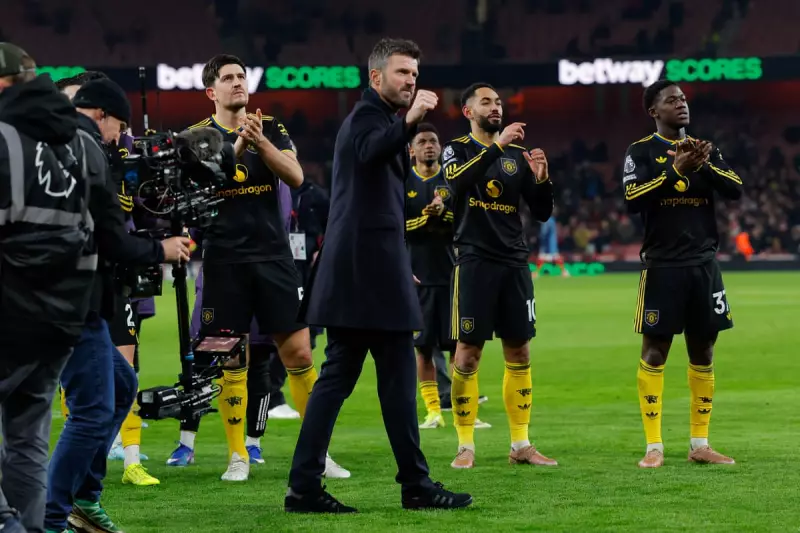
Michael Carrick led his Manchester United players in a heartfelt communion with the travelling supporters following a dramatic 3-2 victory at Arsenal, a moment that encapsulated the renewed belief sweeping through the club under his interim stewardship. The win at the Emirates Stadium, secured by Matheus Cunha's 87th-minute winner, followed a home triumph against Manchester City, marking a stunning start for Carrick.
The Foundation of Success
There is no secret formula or special trick behind Carrick's early impact. Instead, his approach is rooted in a commitment to sound and sensible thinking, focusing on basics that had perhaps been overlooked. This was evident in United's assurance on the ball, with bursts of quick, direct passing that allowed them to escape pressure and advance up the pitch.
While not as pronounced as in the derby win over City, these elements were crucial as United recovered from a challenging opening half-hour at Arsenal. Key moments included the interchanges between Patrick Dorgu and Bruno Fernandes before Dorgu's long-range strike for 2-1, and Kobbie Mainoo's swift move past Declan Rice to set up Cunha for another emphatic finish from distance.

Tactical Clarity and Player Empowerment
Carrick's tactical shift has been significant. Moving away from the previous manager's preference for a back three, he has implemented a 4-2-3-1 formation that better suits the squad's strengths. This system allows both Fernandes and Mainoo, alongside the excellent Casemiro, to operate with greater freedom, rather than being constrained by an extra defender.
The resurgence of Kobbie Mainoo has been particularly noteworthy. After being marginalised under the previous regime, Mainoo has flourished, showcasing his nerveless ball control, ability to receive under pressure, and drive the team forward. His comeback symbolises the fresh energy Carrick has instilled.
Building from the Backroom
Carrick has also made savvy backroom appointments, such as bringing in assistant coach Steve Holland, a boyhood United fan. Additionally, the club's less congested schedule this season, with only 40 games due to cup exits and no European football, has provided valuable training time—a luxury not always available in modern football.
As goalkeeper Senne Lammens noted, Carrick's biggest strength has been sticking to the basics. Lammens emphasised that football is fundamentally about basics, and when executed well, the team's quality naturally emerges. This philosophy has fostered improved defensive cohesion and collective belief.
Challenges Ahead
The true test for Carrick and United will come in the upcoming fixtures against teams like Fulham, Tottenham, West Ham, Everton, and Crystal Palace. Historically, United have struggled against such opponents under the previous management, with a record of three wins, four draws, and seven losses in all competitions against these clubs.
Lammens acknowledged this challenge, stating that matches where United are favourites to win can sometimes be the most difficult, especially when facing low defensive blocks. To be considered a great team, consistent performance against all levels of opposition is essential.
Carrick's bold decisions, such as playing Dorgu on the wing instead of left-back, have paid dividends, with Dorgu starring and scoring against City. Whether Cunha returns against Fulham remains to be seen, but Carrick's willingness to make such calls reflects his pragmatic approach.
In essence, Carrick's cult of common sense has restored belief at Manchester United. By focusing on fundamentals, empowering key players, and implementing sensible tactics, he has provided a blueprint for success that the club will hope to build upon in the coming weeks.