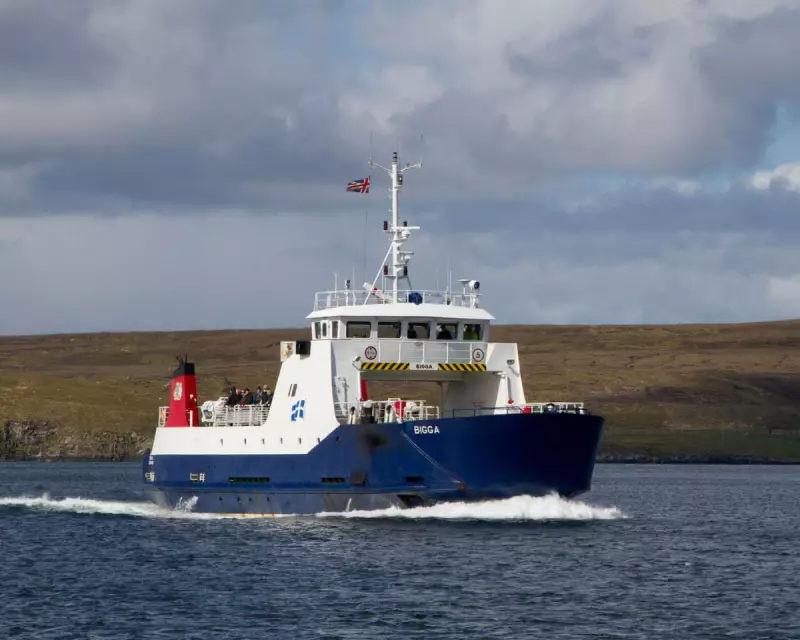
Islanders across Scotland's remote archipelagos are mounting a vigorous campaign for a radical transport solution: replacing ageing, unreliable ferry services with a network of undersea road tunnels. They argue that the current system is a relic of the 20th century, exacerbating depopulation and hindering economic growth, and that fixed links are the only viable future.
The Colossal Waste of Time: A Commuter's Story
For Alec Priest, an instrument technician at the Sullom Voe oil terminal in Shetland, the daily reality of island commuting is a powerful argument for change. His journey from his home in Baltasound on Unst – Britain's most northerly inhabited island – to work involves two separate ferry crossings over the treacherous tidal currents of Bluemull and Yell Sound.
What should be a 34-mile drive becomes a gruelling three-and-a-half-hour round trip. This, combined with his 12-hour shifts, makes the commute unsustainable. "It's a colossal waste of time," Priest states, highlighting how winter gales frequently halt services, creating constant uncertainty. His solution is to live in staff hostels for weeks on end, away from his family. "It's a shame for my family, but it's the only option," he admits.

Learning from the North: The Scandinavian Blueprint
Campaigners on Yell and Unst are looking north for inspiration. They point to the Faroe Islands, where an extensive network of subsea tunnels, including the famous Eysturoyartunnilin with its underground roundabout, has transformed connectivity. Similarly, Norway has linked its islands to the mainland for decades.
In 2025, the islanders took decisive action, commissioning their own geological surveys and hiring Scandinavian tunnel engineering advisers to build a robust economic and social case. They argue the social cost of ferries is immense, driving young families away. Priest notes his own sister relocated to Shetland's Mainland to escape ferry unreliability, and school rolls on Yell fluctuate as families come and go.
The campaign, strongly supported by local Liberal Democrat MP Alistair Carmichael, has successfully placed fixed links on the political agenda. The Scottish government has included them in its strategic transport plan and awarded Shetland £10 million to investigate options, from new ferries to tunnels.
A Nation Divided on Solutions
However, the vision is not universally shared. In the Western Isles, officials are pushing for a continuous "spinal link" of bridges or tunnels to connect islands like Harris, Uist, and Barra. Yet, the local Labour MP, Torcuil Crichton, calls such projects a costly "fantasy solution," arguing that the islands face a "connectivity emergency" now and need immediate investment in new ferries and essential services.
Orkney, meanwhile, is primarily focused on replacing its own council-owned, ageing ferry fleet, a battle with Scottish ministers over funding.
Back in Shetland, proponents like Alice Mathewson, development manager for the North Yell Development Council, counter that tunnels offer long-term resilience. They protect vital utilities, ensure businesses like salmon farms can reach markets, and end dependency on vessels that break down. She estimates tunnels connecting Yell, Unst, and Mainland could cost between £115m and £135m, compared to over £100m for new ferries plus £7m in annual subsidies.
"The ferry service has served our islands very well but that's a 20th-century form of transport," Mathewson asserts. "In the 21st century the answer is: dig a hole. Scotland has to drag itself into the 21st century." With the Scottish budget and an updated infrastructure strategy due, islanders are waiting to see if their modern vision will be embraced.