

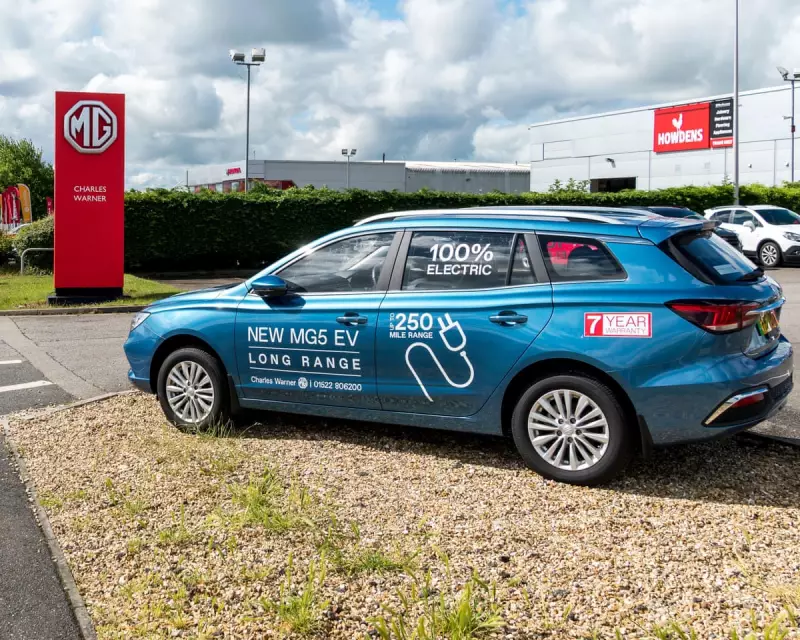
British car sales have roared back to pre-pandemic levels, surpassing two million registrations in 2025 for the first time in six years, according to new industry data. This significant rebound was powered by a dual engine: a record surge in electric vehicle (EV) uptake and a dramatic expansion of Chinese car brands in the UK market.
Chinese Brands Double Market Share
Preliminary figures released by the Society of Motor Manufacturers and Traders (SMMT) reveal a seismic shift in the UK automotive landscape. Chinese manufacturers accounted for 9.7% of all new car registrations in 2025, equating to roughly 196,000 vehicles. This marks a near-doubling of their market share from just 4.9% the previous year.
The UK's open market, which has not imposed tariffs on Chinese imports unlike the US or EU, has provided fertile ground for this growth. Brands like MG, BYD, and Chery (which also operates the Jaecoo and Omoda brands) have made major inroads. BYD sales skyrocketed to 51,000, a six-fold increase, while Chery's brands grew thirteen times to 54,000. MG sold 85,000 vehicles, placing it just behind established giants like Mercedes-Benz and Hyundai.

This influx is further compounded by the fact that Tesla, the American EV pioneer, also exports UK-bound cars from its Shanghai factory, deepening the market's reliance on Chinese production.
Electric Vehicle Sales Hit Record High
Alongside the rise of Chinese marques, the transition to electrification accelerated sharply. Fully electric car sales rose by nearly a quarter year-on-year to a record 473,000 units, capturing 23.4% of the total market. This growth helped slash the average CO2 emissions of new cars sold in the UK by 10% compared to 2024.
However, this progress comes with significant challenges for legacy manufacturers. The industry is grappling with the UK's Zero-Emission Vehicle (ZEV) mandate, which set a headline target of 28% battery-electric sales for 2025. Mike Hawes, SMMT's chief executive, noted the increase was "incredibly positive and good news, but the fact is it's still below where it needs to be."
To stimulate demand, the SMMT calculates that carmakers are offering an average discount of £11,000 on each electric car sold, representing a staggering cumulative cost of £5.5 billion. Discounts for non-battery cars are estimated at around £6,000.
Market Shake-up and Policy Pressure
The rapid ascent of Chinese manufacturers has reshaped the competitive order. Japanese brands like Toyota, Nissan, Suzuki, and Honda were among the biggest losers in market share. Several European marques also felt the pressure, with sales falling for Stellantis's Citroën and Fiat, as well as Volkswagen's Seat.
The policy landscape remains in flux. The UK government already weakened the 2025 ZEV mandate targets in April by adding more "flexibilities," including allowing more plug-in hybrid (PHEV) sales. PHEV registrations duly soared by a third in 2025. Following the EU's proposal to water down its own 2035 combustion engine ban, there is mounting pressure for a further UK relaxation.
According to the Energy and Climate Intelligence Unit, once these flexibilities are accounted for, the industry likely only needed to achieve a 20.4% EV sales share to avoid fines for the second year running.
Hawes criticised the "conflicting message to consumers" created by the government's announcement of a future "pay-per-mile" charge for electric cars, set for 2028, while simultaneously offering purchase grants. He called for an official review of the ZEV mandate to be brought forward to this year, rather than waiting until 2027.
Summing up the year, Mike Hawes described the 2025 sales performance as a "reasonably solid result amid tough economic and geopolitical headwinds," highlighting a market in the midst of a profound and disruptive transformation.






