

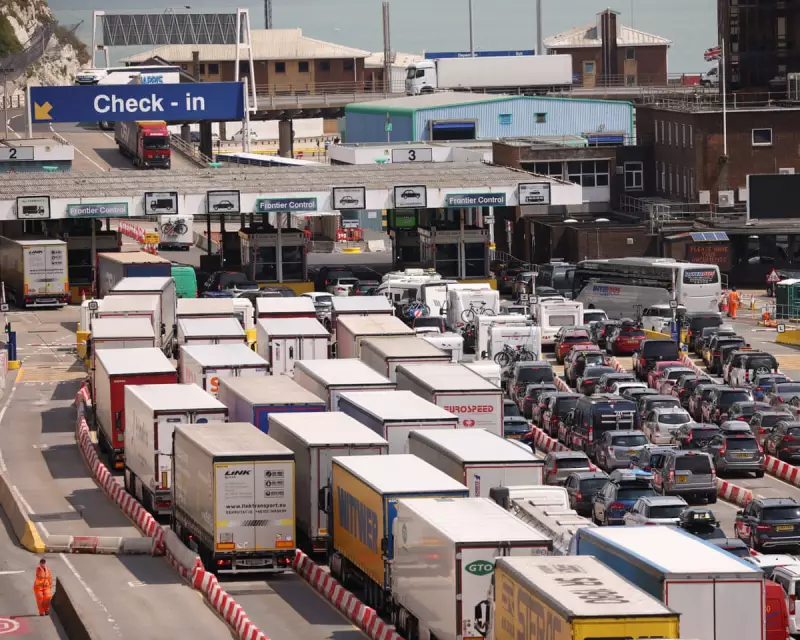
A leading figure in the UK haulage industry has delivered a stark warning to MPs, describing the post-Brexit paperwork regime as "pure hell" and a costly "nightmare" that has left lorries stranded at ports for weeks.
'Light at the End of the Tunnel' Hoped For in EU Reset
Toby Ovens of Broughton Transport gave explosive evidence to the House of Commons Business and Trade Committee. He expressed hope that a potential reset of the UK's relationship with the European Union could provide "light at the end of the tunnel".
Ovens brandished a thick wad of documents required to export meat to the continent, which now needs 26 official stamps. He contrasted this with the single sheet of paper needed before the UK's departure from the EU.

The logistical chaos has reached absurd levels, with Ovens revealing that British vets have been forced to chase lorries down the M4 motorway after realising a stamp was placed incorrectly on a form. "I've had vets chasing lorries down the M4 because they have suddenly realised they didn't put the stamp in the right place on a piece of paper," he told the committee.
£16,000 Bill and 27-Day Calais Ordeal
The financial and operational toll was laid bare with a specific example. Ovens described his worst experience: a truck loaded with frozen meat was held at Calais for 27 days due to a simple paperwork error.
The fallout was severe. He had to charge his customer £16,000 to cover the cost of drivers sitting with the refrigerated vehicle in France for nearly a month.
Further problems emerged before Christmas, when trucks were detained because French inspectors would not accept new UK paperwork for BSE (mad cow disease) clearance. The solution was as chaotic as the problem: one lorry was rerouted to Chippenham to meet a vet, who provided a bundle of new BSE certificates to be driven to Calais to free the detained vehicles.
Committee chair Liam Byrne MP set the scene, stating that Brexit red tape is costing the UK economy £8.4 billion in extra costs. He noted that goods trade is down 18% compared to five years ago, with food and drink exports plummeting by 24%.
Negotiations Begin to Cut the Red Tape
Ovens's testimony comes at a critical moment. EU negotiators are preparing for their first meeting in London next week to discuss a new veterinary agreement, aimed at slashing this burdensome bureaucracy.
A second meeting is scheduled for Brussels the following week as both sides attempt to hammer out a Sanitary and Phytosanitary (SPS) agreement. However, significant hurdles remain.
Tom Bradshaw, President of the National Farmers' Union, highlighted technical divergences, such as UK oat farmers being permitted to use four mycotoxins not yet approved in the EU. He questioned whether this would require a complex transition agreement.
Sean McGuire of the Confederation of British Industry added that the EU has been "very, very lukewarm" on parallel issues like the mutual recognition of professional qualifications, including for architects.
The evidence session served as a powerful confirmation of the stark warnings issued before Brexit by exporters, hauliers, and small businesses who feared they could not shoulder the administrative and financial burden of the new trading reality.






