

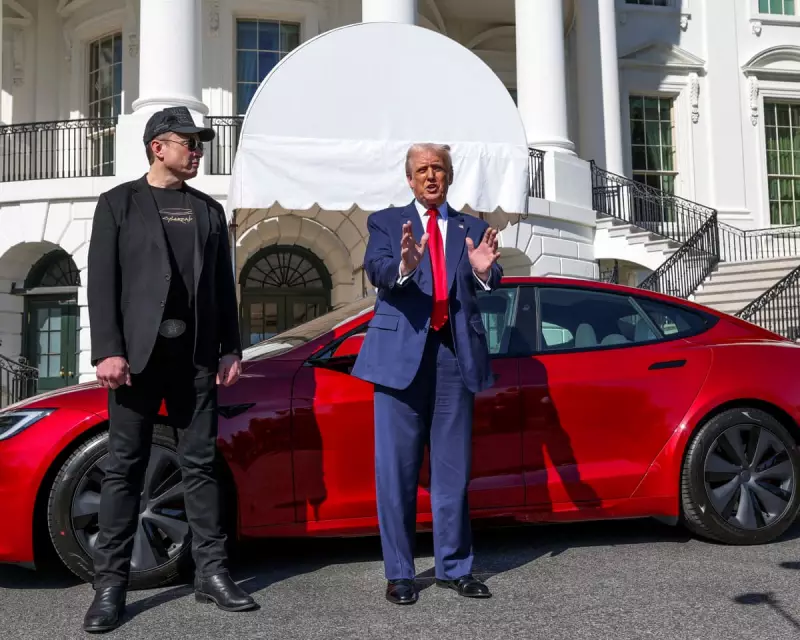
A striking photograph from March 2025 captured Elon Musk alongside Donald Trump and a Tesla at the White House, a visual emblem of the polarising billionaire's deepening political entanglements. This alignment is now having tangible consequences for his automotive empire, as European consumers appear to be turning away.
The European Backlash and Chinese Ascent
Tesla's market share in the European Union fell sharply in November, dropping from 2.1% to just 1.4% of new car sales. This precipitous decline is widely interpreted as a consumer reaction to the Musk brand, which has become synonymous with far-right rhetoric and controversial political endorsements. Notably, even some Tesla drivers have been observed showing support at anti-Tesla protests, indicating a disconnect between the product and its owner's escalating agenda.
While Tesla stumbles, its competitors are seizing the opportunity. Chinese automaker BYD recorded the fastest sales growth in Europe during the same period. Furthermore, SAIC, the state-backed Chinese parent company of MG, saw impressive sales growth of 26%. The data confirms a crucial point: the retreat is from Tesla, not from electric vehicles. Hybrid models, appealing to those still cautious about full electrification, accounted for nearly half of all new car sales in November.

Beyond the Musk Persona: The Real EV Revolution
The debate around electric vehicles perfectly mirrors the broader, complex conversation about achieving net zero. Purists rightly argue that a shift away from private car ownership entirely, towards shared mobility and 15-minute cities, is the ultimate goal. The environmental cost of mining rare metals for EV batteries also remains a significant, unavoidable drawback.
However, the EV story is fundamentally one of relentless and rapid improvement. Early models like the Nissan Leaf had laughably short ranges, often struggling to travel 50 miles. Today, even basic models can cover nearly 300 miles on a single charge. The horizon promises even greater leaps, with solid-state batteries entering trials next year with the potential for 500 miles of range from a mere 10-minute charge.
Practically, the ownership experience has transformed. The instant torque of electric motors means they outperform traditional petrol cars in acceleration, a former bastion of 'petrolhead' pride. Charging infrastructure is becoming ubiquitous, with public points more common and home installation costs falling.
A Nuanced Takeaway for the UK Market
The central lesson for British consumers and policymakers is to disentangle the technology from the tycoon. The electric vehicle revolution is not Elon Musk's story; it is a story of collective global ingenuity and market forces responding to a clear demand for better, cleaner transport. Allowing disdain for one individual to taint the entire sector is a mistake. The advances in battery tech, performance, and infrastructure are real and accelerating, driven by a wide array of manufacturers from Europe, America, and increasingly, China.
The UK's path to net zero requires pragmatism. While systemic change in how we travel is essential, the dramatic improvement and adoption of EVs represent a clear, present win in reducing fossil fuel dependence. The market is speaking: people are choosing electric and hybrid options, just not exclusively from the company whose CEO's politics now overshadow its products.






