

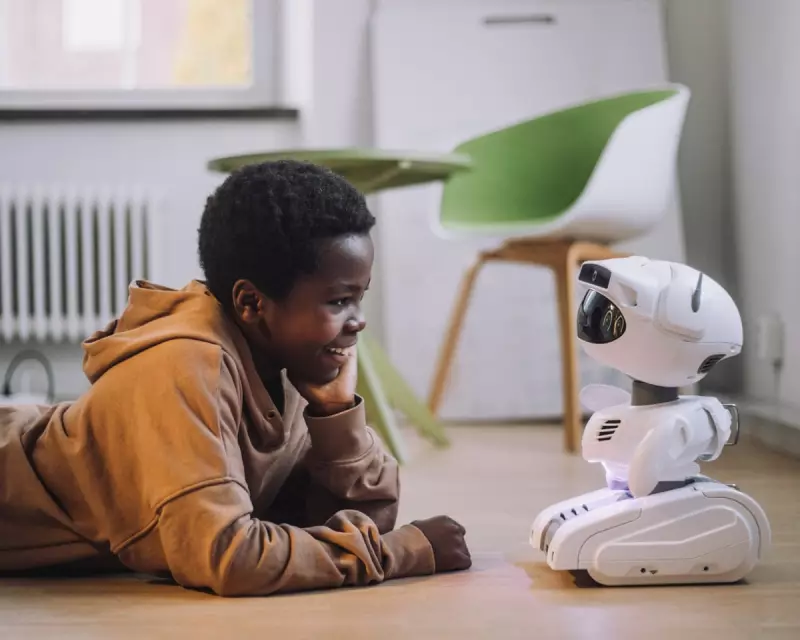
Watching daytime news on mute at the gym recently, digital rights advocate Samantha Floreani encountered a vision of a future she found deeply unsettling. Between reports on global crises, a segment introduced NEO, billed as the "world's first consumer-ready humanoid robot" designed for domestic life. Its soft, grey body and blank face with small camera eyes prompted an immediate, visceral reaction. The promise of a walking, talking machine in the home felt less like a technological breakthrough and more like a step into a surveillance dystopia.
The Creepy Reality Behind the Consumer Robot
The privacy implications of such a device are staggering. While smart speakers listen and robot vacuums map our homes, a humanoid robot like NEO represents a quantum leap in intrusion. Its functionality depends on an array of sensors, cameras, and pervasive data collection. Most alarmingly, for tasks it cannot handle autonomously, it relies on an "expert mode". This is essentially a remote human operator who can see through the robot's eyes and control its actions via a VR headset. For Floreani, the idea of a remote employee having a live, mobile view inside a private home is a fundamental breach, far exceeding current smart home concerns.
This scenario is part of a long history of automation's promises falling short. Tech firms frequently overstate their products' capabilities, relying on hidden human labour to create the illusion of advanced intelligence. Amazon's robotaxi service, for instance, uses remote human drivers to intervene when its vehicles struggle. This phenomenon, dubbed "fauxtomation" by scholar Astra Taylor or "Potemkin AI" by Jathan Sadowski, reveals a marketing ploy that masks exploitation as progress.

Do Labour-Saving Devices Actually Save Labour?
Beyond the privacy nightmare, there is a fundamental question about what these robots are truly for. The longstanding pledge of technology to liberate us from housework has a poor track record. Researchers Helen Hester and Nick Srnicek have documented how domestic technologies, from washing machines to refrigerators, failed to reduce the overall burden of household labour. This is known as the Cowan Paradox: labour-saving devices do not result in less work being done.
The reason is twofold. Firstly, these technologies individualised tasks that were once communal, concentrating undervalued labour on the isolated figure of the housewife. Secondly, they raised standards and expectations, effectively creating more work. This process has systematically devalued the essential, often feminised, labour that sustains daily life and the wider economy. Recent developments in generative AI suggest a similar pattern, often generating low-quality "workslop" that increases, rather than decreases, human workload.
Funwashing and the Capitalist Smart Home
Since that gym encounter, Floreani's social feeds have been flooded with clips of humanoid robots—some failing comically to perform simple tasks, others dancing for applause. This tactic, "funwashing," is a deliberate strategy to humanise and normalise potentially disturbing technology. It brings to mind military robots performing DJ sets or Boston Dynamics' robotic dogs featured in art exhibitions to appear "joyful." The aim is to soften the public's perception of machines that are, at their core, tools for data harvesting, control, and profit.
Priced at around A$30,000 (approximately £15,500), these robots are currently a niche luxury. However, their trajectory is clear. The modern smart home, now aspiring to include robotic servants, is a capitalist product with predictable goals. For Samantha Floreani, the combination of intrusive surveillance, hollow promises of automation, and the historical failure of domestic tech to truly liberate is conclusive. When these robots eventually become affordable, her stance is unequivocal: count me out.






