In a powerful counter-narrative to reductive political rhetoric, former Archbishop of Canterbury Rowan Williams has highlighted the profound and foundational role migrants play in shaping Britain's cultural landscape. He argues that from medieval cathedrals to contemporary art and popular music, the nation's story is inextricably interwoven with the creativity of those who have travelled, often under duress.
The Danger of a Two-Dimensional Narrative
Williams critiques the simplistic and often hostile portrayal of those seeking asylum in the UK. This narrative, he suggests, paints migrants as simultaneously wanting to benefit from British society while undermining its values, reducing complex human beings to a monolithic threat. He points to the way serious issues, like the "grooming gangs" scandals, are twisted into a broader cultural indictment, fostering a climate where a suspect's ethnicity is demanded instantly after major crimes.
This myth-making, Williams contends, obscures the rich cultural hinterland and human agency of migrants. It ignores their histories, values, and the creative worlds they carry with them, presenting them instead as a faceless, dangerous other.

Art as Testimony and Connection
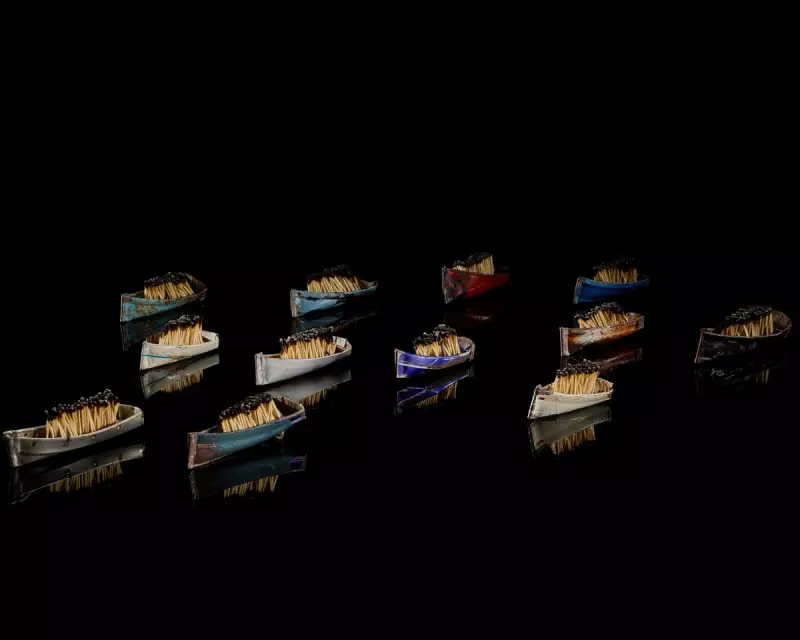
One vital way to push back is through art that centres migrant experiences. A striking example is the work of Syrian-born artist Issam Kourbaj, now based in Cambridge. His installation Dark Water, Burning World, exhibited in the UK and US, uses the ancient form of a Syrian model boat to speak powerfully to contemporary displacement.
Beyond formal gallery art, Williams emphasises the personal "art" of objects carried in flight. At a 2019 colloquium in Cambridge, he heard from individuals like photographer Dragana Jurišić, who fled Croatia as a teenager. She described grabbing a Bible, not from religious belief, but as a tangible piece of her culture. Years later, she found passages she had unconsciously marked served as mantras during her escape. "She needed to know she was not travelling alone," Williams notes.
Migrant Forms Are British Forms
This creativity is not an exotic addition but a core component of British and Western culture. Williams calls these "migrant forms" – the product of a mobile, often unjust world. He provides compelling historical evidence: the development of characteristic western medieval architecture seen in Westminster Abbey was influenced by the exchange of ideas between Europe and the Middle East during the Crusades.
Similarly, modern Western popular music is unthinkable without the Black American tradition, which itself reshaped African idioms under the brutal conditions of enslavement. Even the Hebrew scriptures, he argues, found their present form during the forced displacement of the Babylonian exile.
For Williams, paying attention to the imagination of newcomers is an urgent task. It challenges dehumanising rhetoric and reveals that migrants are not ciphers for a sinister worldview, but individuals with deep histories and creative agency. "Paying attention to their imagination may even release our own, helping us to see ourselves in a new light," he concludes.