

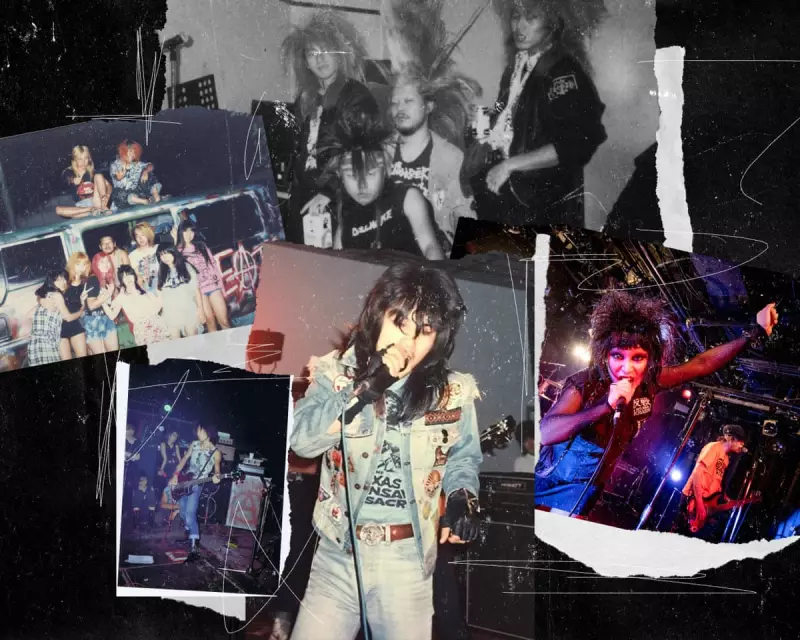
While hardcore punk enjoys a modern-day commercial renaissance, its original, dangerous spirit lives on in the newly reissued records from Japan's foundational 1980s scene. For bands like Death Side, Lip Cream, and the Nurse, being a punk meant societal ostracisation, violent gigs, and a fierce rebellion against overwhelming pressure to conform.
The Thrill and Threat of Japanese Hardcore
A few years after punk's first wave, the genre evolved into a faster, more aggressive form: hardcore. Today, it has entered the mainstream, but its original underdog ethos is powerfully preserved in the archives of Japan's early scene. "It was extremely violent and frightening," recalls Ishiya, frontman of the pivotal band Death Side. "At every gig, someone would be beaten bloody, and you never knew when it might be your turn. That tension was something you could never experience in ordinary life – it was thrilling."
Tokyo in the late 80s and early 90s was a hotbed for furious acts like GISM, Gauze, the Comes, Bastard, and Tetsu Arrey. Yet, the on-stage camaraderie contrasted sharply with the isolation faced off-stage. Ishiya, who sported a magenta mohawk, explains their deliberate defiance: "Our basic stance was to rebel against society and 'common sense'... In Japan, the pressure to conform is extremely strong, and we were subjected to discriminatory treatment just for looking different. On trains people avoided us... We were treated like enemies of society."

Foundational Acts: Lip Cream and The Nurse
The scene's roots trace back to figures like Minoru Ogawa of Lip Cream. He discovered hardcore through imports at record store UK Edison, inspired by Western bands like Discharge and Chaos UK. After leaving the raw punk band the Comes, Ogawa impulsively invented a new group name, Lip Cream, to secure a spot on a compilation. He recruited members and the band went on to release four albums of frenetic thrash. "Everything I’d experienced in the Comes ended up turning into this stronger drive with Lip Cream," Ogawa says. "I just wanted to keep moving."
Simultaneously, the Nurse emerged as one of the world's first all-female hardcore bands. Singer Neko, a 16-year-old fan of GBH and Discharge, formed the group through ads in Doll magazine. "My family was against me playing punk music," she says, recalling the friction caused by her eccentric makeup and late nights at Shinjuku's Tsubaki House venue.
Violence, Society and a Unique Musical Legacy
Death Side, active between 1987 and 1994, became a landmark act. Ishiya saw hardcore as the perfect outlet for teenage anger. The scene's notorious violence, he suggests, stemmed from a mix of post-war trauma, a samurai ethos, and the gathering of societal outcasts. "When those kinds of people gather together, I think violence naturally breaks out," he notes.
This tendency was amplified by bands like GISM, whose frontman Sakevi used a flamethrower on stage, creating an "extraterritorial space where ordinary rules didn’t apply." Re-entering society was harsh. Zigyaku, guitarist of Bastard, faced discrimination in housing, employment, and venue access. Despite constant trouble on tour, including run-ins with police and yakuza, he valued punk's minority status: "If more than half of Japan’s population became punk, I think it would be a more disgusting world!"
Despite their proximity, each band forged a distinct sound, sharpening each other through rivalry. Ishiya attributes the scene's unique direction to Japan's different musical lineage, rooted in folk and enka rather than rock. "If one rebels, one will likely move in a unique direction," he concludes. Today, this explosive chapter is revived through reissues, with Lip Cream's catalogue on Relapse Records and Death Side and the Nurse's work available via La Vida Es un Mus.






