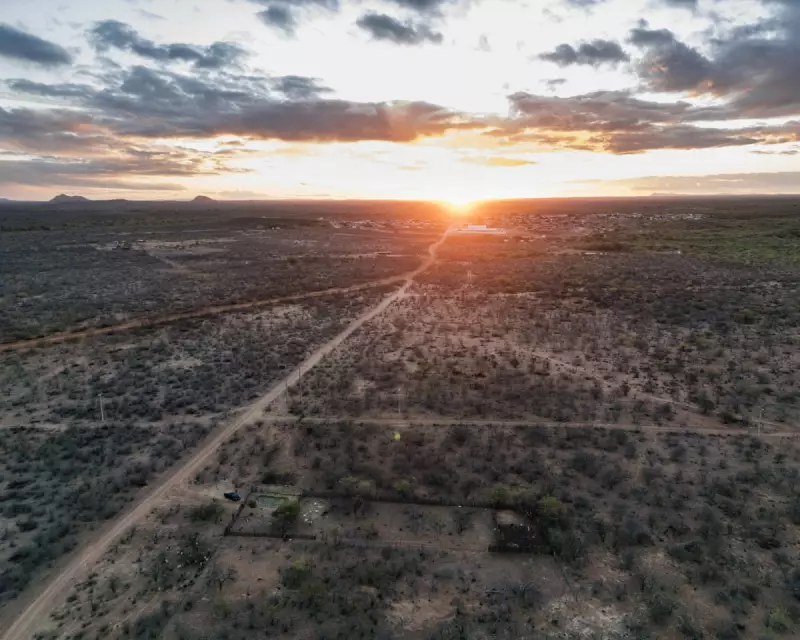
In the harsh, sun-baked landscape of Brazil's north-eastern sertão, a profound and alarming climatic shift is underway. A region once defined by its challenging semi-arid conditions is now crossing a critical threshold, with scientists confirming the emergence of the country's first officially classified arid zone. This transformation, driven by human-induced climate change, is pushing the unique Caatinga biome towards potential desertification, upending centuries-old ways of life.
A Livelihood Drying Up
Every Tuesday at dawn in the small town of Macururé, in Bahia state, goat farmer Raildon Suplício Maia arrives at the market. For him and his community, goats are not just livestock; they are the primary, and often sole, source of income. But the trade is becoming increasingly precarious. The dry season is lengthening, and the native vegetation of the Caatinga—a sprawling shrubland and thorn forest—is withering, leaving even these resilient animals starved for sustenance.
"It used to rain earlier," says Maia, a 54-year-old with a face etched by a lifetime outdoors. "Now, there are no cacti, there's no grass, there's not enough water. We have to spend what we earn from selling the animals on buying feed." Where he once grew corn, beans, and potatoes, the soil now yields nothing. "When you plant something, it dies," he states simply, surveying the bare shrubs around his home.

The Data Confirms a New Climate Reality
This lived experience is now backed by stark scientific evidence. In 2023, researchers from Brazil's National Centre for Monitoring and Warning on Natural Disasters (Cemaden) published a study revealing a dramatic change. They found that a 5,700 square kilometre area in northern Bahia could now be classified as arid—a first for Brazil.
"We never previously had an arid zone in Brazil," explains researcher Ana Martins do Amaral Cunha, a co-author of the study. "It's an area in which the climate changed, from semi-arid to arid. That means it got hotter and drier." The shift is directly linked to anthropogenic global warming. Analysing data from 1960 to 2020, the team found that in this newly arid region, average annual rainfall fell below 400mm during the period 1990 to 2020—a transformation achieved in just one generation.
This aridification threatens to accelerate desertification, a process that already endangers about 13% of the Caatinga. Without urgent action to prevent or reverse soil degradation, largely caused by human activity, this region could become an infertile desert.
Communities on the Frontline and the Search for Solutions
The consequences are felt acutely in communities like the Curral da Pedra quilombo, a traditional Afro-Brazilian settlement. Resident Marisete dos Santos remembers her grandfather's abundant watermelon crops. Now, the fruits she plants are small and dry, and saved beans fail to germinate.
While engineered solutions exist—such as government-provided cisterns and deep rainwater catchment trenches known as barreiro trincheira—they are struggling under the new climate regime. "You don't know any more how long the water will remain stored. The sources empty quicker, because it's hotter," says Gustavo Vieira, Macururé's municipal secretary for agriculture and environment.
The town, with a population of just over 7,000, has seen a 10% decline since 2010 as young people leave. It stands as a stark warning for the rest of Brazil. The Cemaden study found Brazil's semi-arid region expanded by 75,000 sq km every decade between 1960 and 2020, with dry zones also appearing in Rio de Janeiro state and the Pantanal wetlands.
"These changes should also be on our radar. It's not just a problem in the north-east, it's a problem that affects the whole country," warns Cunha. She stresses that once a climate shift of this magnitude occurs, it is irreversible, making mitigation and policies to combat desertification critical. Brazil's environment ministry is expected to present an updated national desertification policy soon.

For now, in Macururé, where goats outnumber people 30 to one, the bond to the land and its traditions remains, even as it becomes more fragile. As goat herder Venancio Lorenzo do Santo watches the sunset over his pen, his resolve is tinged with uncertainty: "The day I stop breeding goats, I know I'm going to have to leave."