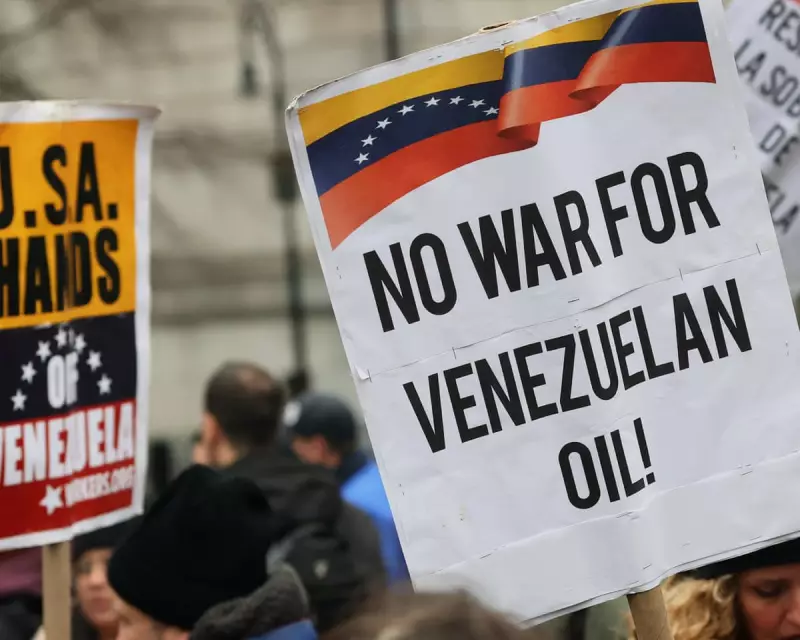
In a dramatic escalation of tensions, the United States military launched an attack on Venezuela in early January 2026, resulting in the capture of President Nicolás Maduro and his wife, Cilia Flores. The operation, authorised by President Donald Trump, has been justified by Washington as a necessary strike against drug trafficking and illegal migration. However, a leading Venezuelan academic asserts this narrative is a smokescreen for a more cynical objective: the plunder of Venezuela's vast resources.
The Official Justification vs. The Historical Reality
In the early hours of 3 January 2026, US forces bombed Caracas and other Venezuelan cities, kidnapping the nation's president. The Trump administration's initial public rationale pointed to combating the illegal drugs trade and stemming a flow of migrants allegedly orchestrated by Caracas. This justification was used to legitimise a military deployment in the Caribbean that had, in the preceding months, already caused approximately 100 deaths from attacks on small boats.
Andrés Antillano, a social psychology professor at the Central University of Venezuela with two decades of research into the country's drug trade, finds this reasoning deeply flawed. He acknowledges Venezuela's historical role as a cocaine transit corridor, neighbouring major producers. This role intensified in the early 21st century due to European demand, the displacement effects of Plan Colombia, and a breakdown in cooperation with the US.

However, Antillano highlights a crucial shift. "According to the UN World Drug Report 2025, only 5% of Colombian cocaine now passes through Venezuela," he notes. This significant decline is attributed to factors like increased Caribbean seizures pushing traffic to the Pacific, and the fragmentation of criminal groups in Colombia. For Antillano, the key reason is Venezuela's own internal chaos: the profound fragmentation among state and criminal actors creates unpredictable, insecure routes for traffickers who require stable, corruptible systems.
Debunking the 'Cartel de Los Soles' and Migration Myths
The Trump administration also invoked the spectre of the "Cartel de Los Soles" – a term used for decades to allege links between high-ranking Venezuelan military officials and drug trafficking – as a reason for the special forces operation. Antillano argues that if this cartel has existed for nearly 40 years, as press reports suggest, it is not a creation of the Chávez or Maduro governments specifically. Notably, he points out that the US prosecution charging Maduro in New York refrained from alleging his participation in such a coordinated structure, likely due to a lack of evidence.
On the issue of migration, which Trump weaponised during his 2024 campaign, Antillano challenges the narrative of a state-sponsored criminal exodus. While millions have fled Venezuela's crisis, studies show no disproportionate involvement of Venezuelans in crime in host countries. The notorious Tren de Aragua gang, cited by Trump as a terrorist group in league with the government, is assessed by experts as lacking a centralised command structure abroad. Even US intelligence sources, Antillano states, have found no evidence linking the gang to the Venezuelan state.
The Underlying Motive: Wealth and Regional Dominance
Antillano concludes that the Trump administration is resorting to "the usual suspects" – drugs, terrorism, and migration – to manufacture a folk devil and legitimise aggression. The real motives, he contends, are far more traditional: the seizure of Venezuela's considerable natural wealth and the intimidation of the wider Latin American region into submitting to Washington's will.
The arrest of Maduro and Flores, culminating in their arraignment at a New York courthouse on 5 January 2026, is thus framed not as a victory for justice or security, but as the opening move in a resource grab. The human cost, including the 100 deaths recorded from the initial bombings, becomes, in this analysis, collateral damage in a geopolitical power play disguised as a law enforcement operation.