

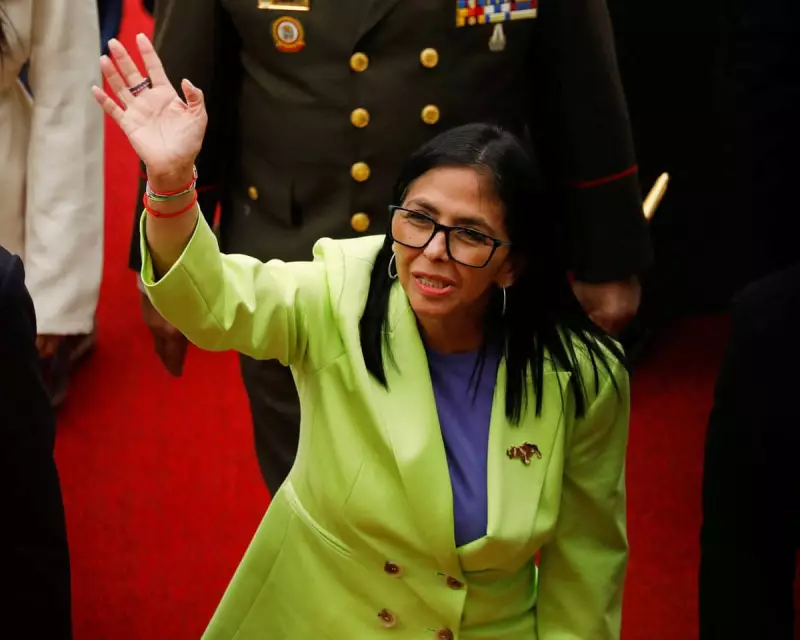
In a dramatic twist to Venezuela's political saga, the director of the United States Central Intelligence Agency has held talks with the country's new acting president, just weeks after his agents reportedly helped to oust her predecessor.
A High-Stakes Meeting in Caracas
CIA chief John Ratcliffe flew to Caracas on Thursday to meet Delcy Rodríguez, who assumed the role of acting president after the extraordinary rendition of Nicolás Maduro by US special forces on 3 January. The visit, confirmed by a US official to the New York Times, aimed to foster an improved working relationship with the remnants of Maduro's regime now led by Rodríguez.
The encounter was laden with irony, coming less than a fortnight after Ratcliffe's agents played a pivotal role in infiltrating Maduro's inner circle. Their intelligence was so precise they reportedly knew details of his meals and pets before he was seized from what was considered Venezuela's most fortified location.

During a state of the union address—a speech Maduro had expected to deliver himself—Rodríguez stated Venezuela "had the right" to good relations with the US. She expressed willingness to travel to Washington for talks with representatives of the "lethal nuclear power."
Machado's Bid and a Symbolic Gift
As this diplomatic manoeuvring unfolded, sidelined opposition leader María Corina Machado made a bold declaration. In a Fox News interview broadcast on Friday, the conservative politician predicted freedom was coming to Venezuela after years of economic chaos and authoritarian rule.
"And I believe I will be elected, when the right time comes, as president of Venezuela - the first woman president of Venezuela," she stated.
Her comments followed a controversial visit to Washington the previous day, where she presented her Nobel Peace Prize medal to former US President Donald Trump. She framed the gesture as recognition for his "principled and decisive move" against Maduro. However, experts widely viewed the meeting as a humiliation for the Nobel laureate, with Machado reportedly leaving via a back door.
Trump's Calculated Pivot to Rodríguez
Despite Machado's confidence, analysts note that the Trump administration has actively marginalised her opposition movement. Rather than backing Machado—whose coalition is widely believed to have beaten Maduro in the 2024 presidential election—Trump has endorsed Maduro's former vice-president.
Trump publicly called Delcy Rodríguez a "terrific person," and his officials have been open about striking a deal with Maduro's closest allies, many implicated in serious human rights abuses. US Energy Secretary Chris Wright explained the rationale on CBS News, stating: "We need to work with the people that have the guns today to ultimately move the country to a representative government... But what you’ve got to prevent in the meantime is a collapse of the nation."
Reports suggest Trump's decision was based partly on personal animosity towards Machado and partly on CIA assessments that she could not prevent a security collapse by controlling the military and armed pro-regime groups.
Rodríguez now governs as acting president with support from key Maduro allies, including the feared interior minister Diosdado Cabello, and has vowed to improve US ties. Her administration is already complying with a key Trump demand by opening Venezuela's vast oil reserves to US companies. A tangible sign of cooperation came on Friday, when the first US deportation flight since Maduro's capture landed in Caracas carrying 231 Venezuelans.
Experts Doubt Machado's Comeback Prospects
Observers are sceptical that Machado's Nobel medal gambit will alter the political calculus. Eva Golinger, a US lawyer who advised Hugo Chávez, noted: "Delcy is giving him everything he wants. He has no reason to disrupt the situation – and he’s certainly not going to let María Corina Machado come in and try to shake things up."
Golinger added that the Rodríguez administration's actions had stripped away the pretext of anti-imperialist socialism, calling the situation "farcical" and a "clear betrayal" of the Chavismo movement's principles.

Imdat Oner, a former Turkish diplomat in Venezuela and fellow at Florida International University, concurred. He stated Machado's hands were tied and her becoming president was "completely out of the question for now," adding that the opposition had bet fully on the Trump administration to remove the regime, a scenario which did not materialise.
The political landscape in Venezuela remains volatile, with the CIA chief's visit underscoring a pragmatic, if controversial, US shift towards engaging with the existing power structure in Caracas, leaving the formal opposition sidelined for the foreseeable future.





