

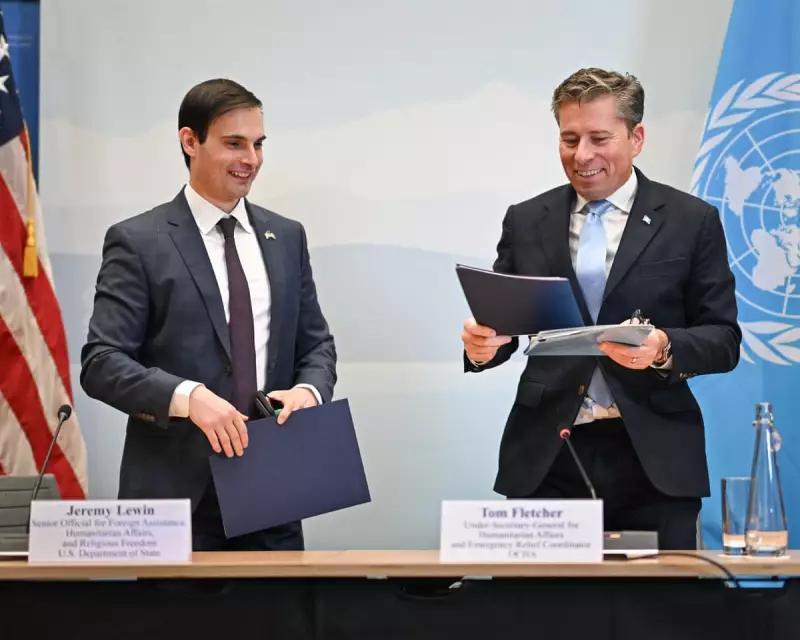
A major new $2bn (£1.5bn) humanitarian aid pledge from the United States has been met with deep concern by experts, who warn its stringent conditions could force the United Nations into a subservient role, prioritising Washington's political interests over global need.
'Adapt, Shrink or Die': The US Ultimatum
The pledge, announced this week by the US State Department, was accompanied by a stark message for the UN humanitarian system: it must 'adapt, shrink or die' by implementing sweeping changes and cutting perceived waste. The funds are to be channelled exclusively through a single pooled fund under the UN's Office for the Coordination of Humanitarian Affairs (Ocha), rather than distributed to individual agencies.
Furthermore, the US has stipulated that the money can only be used in 17 priority countries of its own choosing. Notably absent from this list are nations enduring profound humanitarian catastrophes, including Afghanistan and Yemen.

Experts Decry 'Despicable' Shift and UN Subservience
Aid analysts have reacted with alarm to the terms. Independent researcher Themrise Khan criticised the approach as 'a despicable way of looking at humanitarianism'. She highlighted the UN's public praise of the pledge as 'generous' despite the heavy conditions, stating it 'points to the fact that the UN system itself is now so subservient to the American system'.
'For me, that is the nail in the coffin,' Khan added.
The selected countries, which include Sudan, Haiti, and the Democratic Republic of the Congo, align with clear US political interests. Independent UN finance analyst Ronny Patz noted that announcing a pre-selected list 'shows they have very clear political priorities for this money'.
A 'Shrunken' System and Uncertain Funds
Patz warned that Washington's demands risk solidifying a 'massively shrunk' UN humanitarian system, ill-equipped to respond to new crises outside the US-approved list. 'If there is a new humanitarian crisis breaking out in some region of the world next year that they haven’t prioritised funding for, it’s not clear that they are willing to let the UN respond with US money,' he said.
There is also scepticism about whether the $2bn sum represents genuine new support. Thomas Byrnes, CEO of MarketImpact, revealed the amount is significantly less than the $3.38bn provided by the US in 2025 under the previous Biden administration. He described the announcement as 'a carefully staged political announcement that obscures more than it reveals'.
The context of other US cuts deepens concern: a $5bn reduction in approved foreign assistance labelled 'woke, weaponised and wasteful', and a proposal to end support for peacekeeping missions, where the US already owes the UN $1.5bn.
Both Byrnes and Patz raised concerns that channelling funds through Ocha may be less about partnership and more about centralising control. Patz also cautioned that the money is not yet guaranteed, contingent on the UN meeting US Secretary of State Marco Rubio's demands to 'cut bloat, remove duplication'. 'I would be cautious,' Patz concluded. 'This is $2bn promised, but not $2bn given.'






