

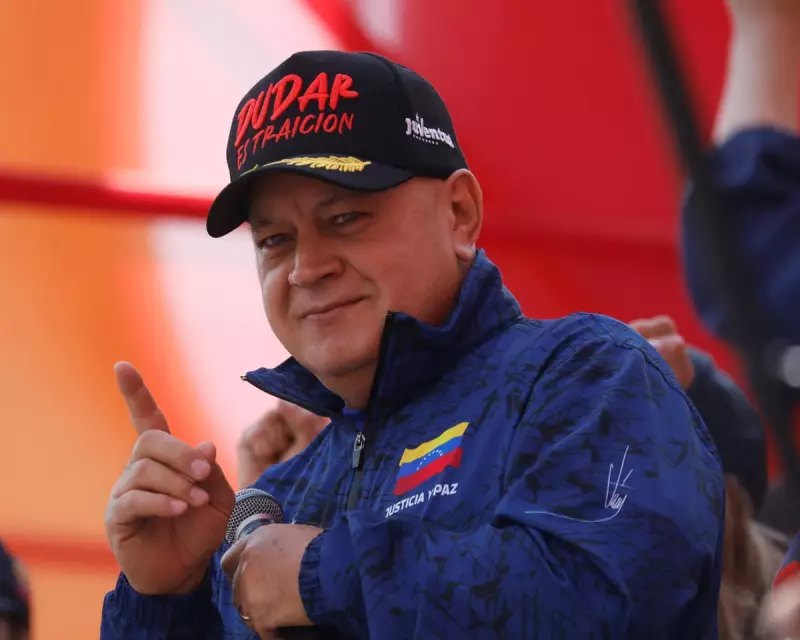
In the intricate and often opaque political landscape of Venezuela, one figure stands as a constant, formidable force. While President Nicolas Maduro occupies the official seat of power, the influence of Diosdado Cabello, the first vice president of the ruling United Socialist Party of Venezuela (PSUV), is widely considered to be equally, if not more, significant. Often described as the regime's enforcer and chief strategist, Cabello's journey from military officer to political kingpin offers a crucial lens through which to understand modern Venezuela.
From Military Roots to Political Command
Diosdado Cabello's path to power is deeply intertwined with the Bolivarian Revolution itself. His early career was in the military, where he formed a pivotal bond with a fellow officer, Hugo Chavez. This alliance proved fateful. Cabello was a key participant in Chavez's failed 1992 coup attempt, an event that, despite its immediate failure, launched Chavez into the public consciousness and set the stage for his eventual electoral victory.
Following Chavez's ascent to the presidency in 1999, Cabello's star rose rapidly. He held a succession of high-profile roles, including the governorship of Miranda state and the powerful position of interior minister. Perhaps most tellingly, he briefly served as president of Venezuela for a few hours in 2002 during the chaotic 48-hour coup that temporarily ousted Chavez. This episode underscored his position as a trusted lieutenant in the innermost circle.

After Chavez's death in 2013, a subtle but intense power struggle ensued. While Nicolas Maduro, Chavez's chosen heir, secured the presidency, Cabello consolidated control over the party apparatus and key state institutions. His role as president of the pro-government Constituent Assembly, a body created in 2017 that effectively sidelined the opposition-led National Assembly, cemented his reputation as the regime's institutional architect and hardline guardian.
The Power Behind the Throne: Influence and Allegations
Today, Cabello's influence is pervasive. He is the host of a weekly television show, "Con el Mazo Dando," where he delivers lengthy, combative speeches that set the political agenda, denounce opponents, and signal policy directions. This platform grants him a direct line to the party faithful and acts as a powerful tool for political messaging, independent of the presidential office.
His authority extends deep into the state. He is believed to wield considerable influence over the military, intelligence services, and the judiciary. This network of control has led to him being labelled by critics and foreign governments, particularly the United States, as the head of a corrupt network often referred to as the "Cartel of the Suns." The US Treasury Department has sanctioned him for alleged involvement in drug trafficking and money laundering, accusations he vehemently and repeatedly denies.
Cabello dismisses these allegations as politically motivated attacks aimed at destabilising the Venezuelan government. He positions himself as a staunch defender of national sovereignty and the revolutionary project against what he terms imperialist aggression.
A Defining Force in Venezuela's Future
The dynamic between Cabello and Maduro is a subject of intense speculation. Analysts often describe a diarchy or a balancing act, where Maduro manages the presidency and international relations, while Cabello ensures domestic control and party discipline. This division of labour has proven resilient in the face of severe economic crisis, widespread international sanctions, and political pressure.
As Venezuela navigates a period of tentative and fraught negotiations with parts of the opposition, Cabello's stance is critical. He is typically viewed as representing the hardline, uncompromising faction within Chavismo, sceptical of concessions. Any significant shift in policy or potential opening in the political system would likely require his assent, making him an indispensable, if often controversial, figure in any discussion about Venezuela's future.

His story is more than a personal political biography; it is a reflection of the evolution of Chavismo from a revolutionary movement into a structured, if highly personalised, state power. Whether seen as a ruthless operator or a loyal revolutionary, Diosdado Cabello remains a central pillar in the structure that governs Venezuela, his influence undimmed as the nation confronts its ongoing challenges.





