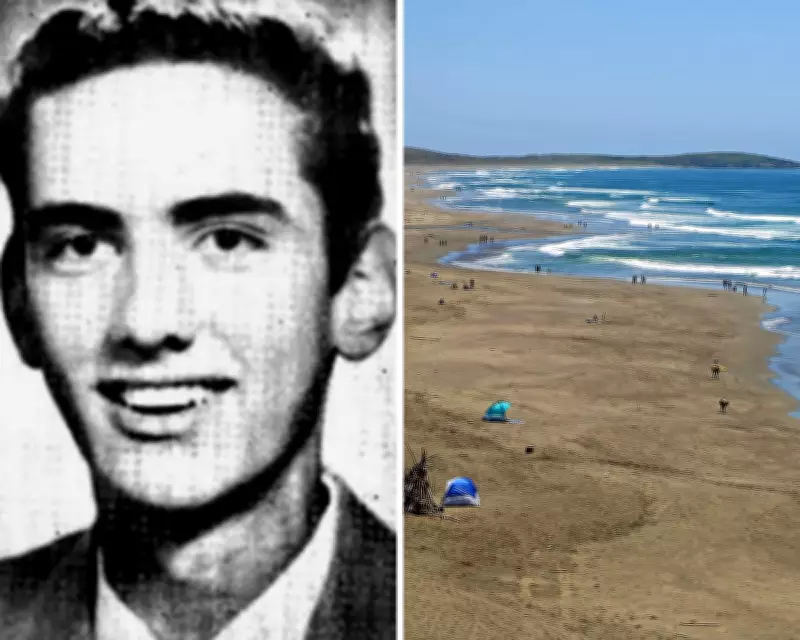
DNA Doe Project Solves Decades-Old Mystery of Missing Banker Found on California Beach
The DNA Doe Project (DDP) has announced a breakthrough in a long-standing cold case, identifying human remains discovered on Salmon Creek state beach in northern California as those of Walter Karl Kinney, a 59-year-old former banker who vanished in 1999. The bones were found in June 2022 by a family collecting seashells, leading to an extensive investigation that combined forensic science and genealogical research.
Discovery and Initial Challenges
In the summer of 2022, a family stumbled upon a bone embedded in the sand at Salmon Creek state beach. The bone contained surgical hardware, and a subsequent pathology examination suggested it was a tibia. However, searches of the surrounding area failed to uncover additional remains, leaving authorities initially unable to determine the identity of the individual. The Sonoma county sheriff's office then enlisted the help of the DNA Doe Project, a nonprofit organization specializing in identifying unknown persons through genetic genealogy.
Genealogical Breakthrough and Identification
The DDP's team of investigative genealogists worked pro bono on the case, developing a DNA profile from the remains and uploading it to GEDmatch, a public genealogy database, in January 2026. This led to the identification of a family that had relocated from the east coast to California, eventually settling in the San Diego area. By tracing the family lineage, investigators connected the remains to Walter Karl Kinney, who was born in 1940 in San Diego and later moved to Santa Rosa, a location relatively close to Salmon Creek state beach.

A critical clue emerged when team members discovered an article about human remains that had washed ashore in 1999, just a couple of miles south in Bodega Bay. In 2003, a woman contacted investigators regarding her father, who had last been seen on August 10, 1999. Using X-ray records, authorities confirmed that the partial remains found in 1999 belonged to her father, Walter Karl Kinney. The DDP's recent findings corroborated this, leading to a definitive identification after just over a week of intensive work.
Personal Reflections and Case Significance
In a statement attributed to Kinney's daughter, she described her father as "smart, sensitive, almost to a fault," adding that "this world was just too harsh a place for him." Traci Onders, a DDP team leader, noted the unusual nature of the case, stating, "It's not often we see someone end up as a John Doe twice." She emphasized the power of investigative genetic genealogy in resolving such mysteries, saying, "Thanks to investigative genetic genealogy, we were able to resolve this mystery and provide some answers to everyone involved in this case."
The Sonoma county sheriff's office expressed gratitude for the partnership, stating, "Thank you to the DNA Doe Project for helping us put a name to the human remains found at Salmon Creek Beach. We value this partnership as we continue working together to identify remains found in Sonoma county." This case highlights the growing role of advanced DNA technology and genealogical methods in solving cold cases and bringing closure to families affected by long-term disappearances.