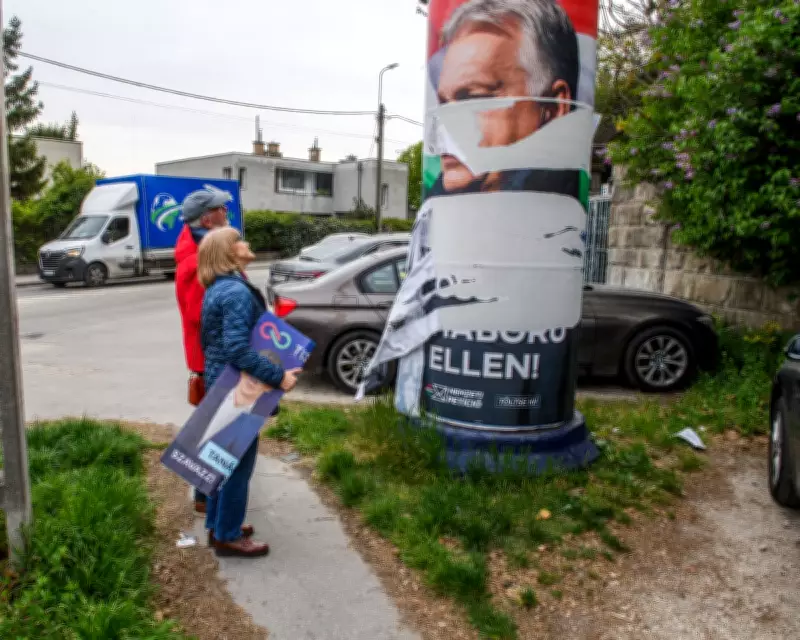
Hungary's Political Landscape Transformed by Opposition Landslide
In the aftermath of a seismic election, Hungary finds itself at a historic crossroads. After 16 years of rule by Viktor Orbán and his Fidesz party, Hungarian voters delivered a stunning rebuke, propelling the opposition Tisza party to a decisive victory. The streets of Budapest pulsed with a mixture of jubilation, disbelief, and cautious optimism as citizens absorbed the reality of a new political era.
A Nation Awakens to Change
The record-breaking voter turnout translated into a commanding win for the centre-right Tisza party, led by Péter Magyar. Securing 138 of parliament's 199 seats grants the party a supermajority, empowering it to amend the constitution and potentially dismantle key structures of what Orbán had termed an "illiberal democracy." For many Hungarians, the result felt surreal.
"I partied all night," confessed Gabor, 40, in a plaza near Budapest's Nyugati station, admitting to a celebratory hangover. "I thought Fidesz was going to win. Now I'm really hopeful." This sentiment echoed across the capital, where spontaneous celebrations erupted along the Danube River, with strangers embracing in metro stations and crowds chanting "We did it!" against a cacophony of honking cars.

The Mobilization of a Generation
Analysts attribute the electoral shift partly to the unprecedented mobilization of young voters. This generation came of age as Hungary's press freedom rankings plummeted, faced accusations of democratic backsliding, and earned the dubious distinction of being perceived as the European Union's most corrupt member state. Their collective voice at the ballot box proved decisive.
Éva, 37, encapsulated the widespread anxiety and subsequent relief: "This morning I was bracing for something to happen – like they would say they found some massive number of ballots that would change the results. Now I'm starting to believe that it could be real." The victory was so comprehensive that some supporters shimmied up lampposts to tear down government posters, symbols of an era many were eager to leave behind.
Péter Magyar: A Complex Figure at the Helm
The triumph places Péter Magyar, a former Fidesz insider, at the nation's helm. His campaign, marked by up to six rallies daily, capitalized on deep public discontent over systemic corruption and deteriorating public services. He crisscrossed the country, pledging to repair Hungary's strained EU relations, crack down on graft, and rebuild crumbling infrastructure.
However, questions about his vision and methods linger. "I feel like we still don't know Péter Magyar so well," admitted Franciska Dombi, 27, while walking her dog. "The way he speaks... sounds very much like the way that Viktor Orbán used to speak. And of course, he's a conservative politician, so I'm not sure how he'll be." Magyar's strategy involved speaking in broad strokes, a tactic seen as necessary to navigate a media landscape where an estimated 80% of outlets are controlled by Fidesz loyalists.
Orbán's Future and the Road Ahead
On Monday, Magyar declared that Hungarians had voted for "a complete change in regime," not merely a change of government. He aims to assume power by early May. Meanwhile, the political future of Viktor Orbán, the EU's longest-serving leader, remains uncertain. Having conceded defeat just hours after polls closed, his next moves are closely watched.
"I feel like this was such a big hit," said Márton Bács, 28, referencing the scale of the defeat. "It was a huge blow; politically I don't believe he can survive it in the long run." Others, like Mariann, 37, suspect Orbán will not retreat quietly, predicting he will attempt to project strength from the opposition benches.

Not Everyone Celebrates
The elation was not universal. Fidesz loyalists expressed disappointment and concern. "I voted for Fidesz and I'm rather sad to see what happened," said Katalin, 72, voicing a common frustration about the lack of detailed plans from the Tisza party. "Maybe I would trust Tisza politicians more if I knew more about them." Márton Üveges, 38, another Fidesz voter, held out hope for Orbán's eventual return after a term in opposition.
A Cautious Hope for the Future
Given the profound changes Orbán's government enacted since 2010—stacking state institutions, media, and the judiciary with loyalists—few expect swift transformations. "It will probably take a couple of years," acknowledged Dombi. The challenges are immense, spanning healthcare, education, and systemic corruption.
Yet, for now, a palpable sense of historic possibility hangs in the air. "We could actually have a country that is really good to live in," Dombi reflected, listing the areas desperate for reform. "This is history being made." As Hungary awakens from 16 years of Orbán's rule, the nation stands between the exhilaration of victory and the arduous work of rebuilding, its path forward shaped by this remarkable democratic expression.