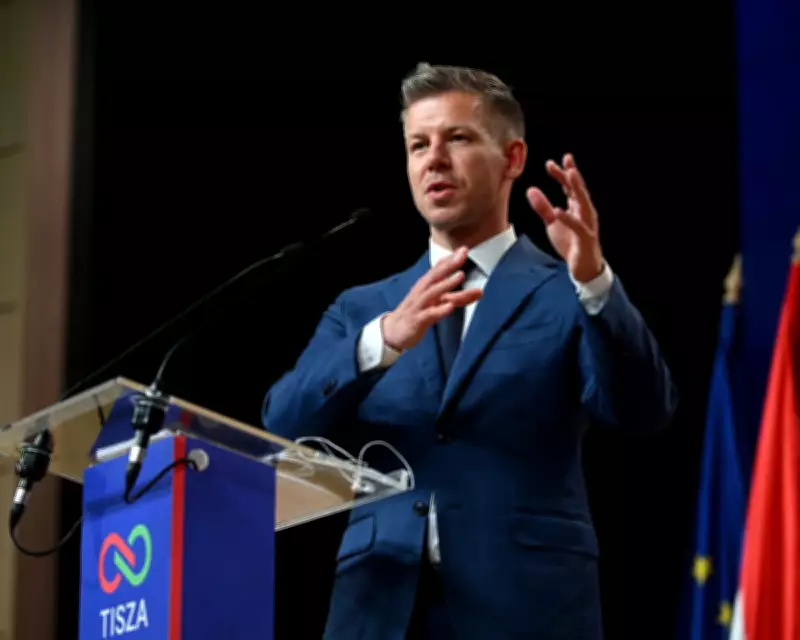
Hungary's New Leader Declares 'New Era' After Crushing Orbán's Regime
Hungary's prime minister-elect, Péter Magyar, has delivered a powerful declaration of intent following his landslide election victory over long-serving nationalist leader Viktor Orbán. The centre-right politician vowed to pursue those who "plundered, looted, betrayed, indebted and ruined" his country, promising a complete transformation of Hungary's political landscape.
Super Majority Secures Transformative Mandate
Magyar's Tisza party secured at least 138 of the 199 parliamentary seats, granting him a decisive two-thirds supermajority that will enable sweeping constitutional changes. This commanding position allows the incoming government to roll back legislation that facilitated Orbán's transformation of Hungary into what critics termed an "illiberal democracy" during his sixteen-year tenure.
"Our country has no time to waste," Magyar declared during a comprehensive press conference on Monday. "The Hungarian people didn't vote for a simple change of government, but for a complete change of regime." He emphasized that full election results should be confirmed by May 4th, with his government expected to be installed the following day.

Comprehensive Reform Agenda Outlined
The prime minister-elect outlined an ambitious reform agenda focused on restoring democratic institutions eroded during Orbán's rule. Key priorities include implementing robust anti-corruption measures, reestablishing judicial independence, and ensuring media freedom. These changes are specifically designed to facilitate the rapid unfreezing of billions in European Union funds previously blocked due to rule of law concerns.
Magyar announced Hungary would join the European Public Prosecutor's Office, granting EU investigators authority to examine fraud cases and scrutinize how bloc funds were utilized under the previous administration. Additionally, he pledged to establish a national asset recovery office to hold "political and economic criminals" accountable for their actions.
Constitutional Changes and Institutional Overhaul
Among the most significant proposed changes is a constitutional amendment limiting future prime ministers to two terms totaling eight years. Applied retroactively, this provision would permanently bar Viktor Orbán from seeking office again. The new government also plans immediate action against state-controlled media, suspending broadcasts from "state-captured" television and radio outlets until unbiased coverage can be guaranteed through new supervisory mechanisms.
Magyar delivered a stern ultimatum to key figures from the previous regime, calling on the heads of Hungary's highest courts, audit office, competition and media authorities, along with the chief prosecutor and current president Tamás Sulyok, to resign immediately. "He was appointed just to sign everything," Magyar stated regarding the president. "We don't need people like that. To me, he is not the president."
European Reactions and International Implications
European leaders responded enthusiastically to the election outcome, despite potential policy disagreements with Magyar's government on issues including migration and Ukraine's EU accession. German Chancellor Friedrich Merz described the result as "a good day" that delivered "a very clear signal against right-wing populism." He anticipated smoother EU decision-making processes, long hampered by Orbán's repeated vetoes.
European Commission President Ursula von der Leyen confirmed Brussels would commence work with the new Hungarian administration "as soon as possible" to address frozen fund releases. "Today Europe is Hungarian without any question," she proclaimed, adding that "the people of Hungary have spoken and they have reclaimed their European path."
However, the Patriots for Europe group in the European Parliament, which includes Orbán's Fidesz party alongside other far-right factions, characterized the election outcome as "a setback" for forces advocating democratic self-determination and traditional European values within the bloc.

Legacy of Orbán's Rule and Future Challenges
Viktor Orbán's four successive governments systematically eroded Hungary's democratic foundations, packing courts with loyalist judges, transforming approximately eighty percent of media into government mouthpieces, and enriching a close circle of allies. His administration repeatedly clashed with the European Union over policies concerning justice, migration, and Ukraine, while maintaining alliances with both Donald Trump and Russia's Vladimir Putin.
Orbán's final months in office were marked by obstructionism, including blocking a substantial €90 billion loan to Ukraine after accusing Kyiv of sabotaging Russian oil deliveries—allegations repeatedly denied by Ukrainian authorities. His government consistently delayed and frequently opposed EU sanctions targeting Russia.
As Hungary prepares for this dramatic political transition, the international community watches closely to see whether Magyar can deliver on his promises to restore rule of law, unlock frozen EU resources, and reposition Hungary firmly within the European mainstream after years of contentious relations.