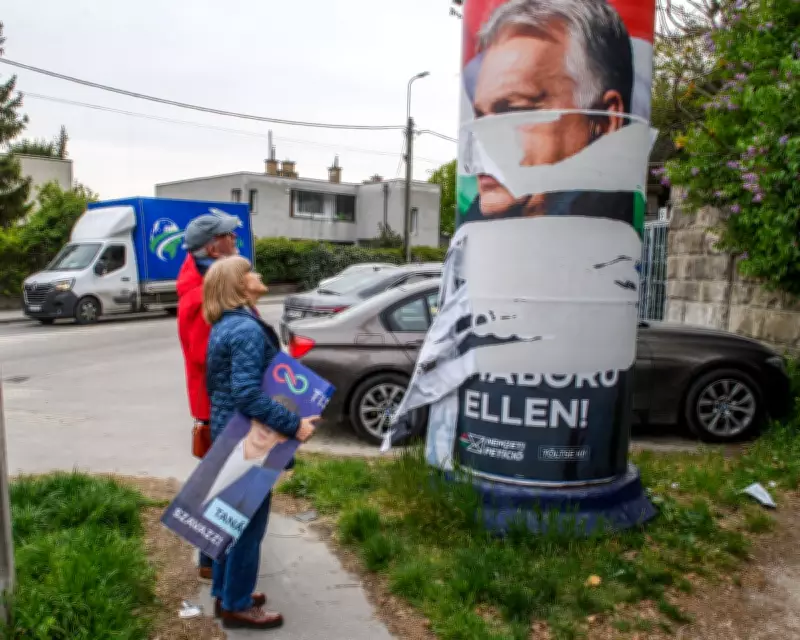
Historic Defeat: Viktor Orbán's 16-Year Reign Ends in Hungarian Election
The recent Hungarian election has delivered a seismic political shift, marking the fall of Viktor Orbán after 16 consecutive years in power. With an unprecedented voter turnout of 79.5%—the highest since the collapse of the Soviet Union—the Hungarian electorate delivered a decisive mandate for change. This outcome represents a significant moment for European liberal democracy, as Orbán, a chief architect of illiberalism on the continent, conceded defeat following a campaign that saw strong youth mobilization and overcame gerrymandered districts and a controlled media landscape.
The Complex Reality Behind the "Budapest Spring"
While the election results have sparked celebrations among proponents of democratic values, experts caution against premature declarations of victory. The term "historic" carries weighty implications, and the process of dismantling 16 years of entrenched authoritarianism will be neither swift nor simple. National-populist regimes do not operate as mere political interludes; they embed themselves deeply within state institutions, leaving scars that require extensive time and resources to heal.
Poland's Parallel: A Cautionary Tale for Democratic Restoration
The Polish experience under Donald Tusk's Civic Coalition offers a sobering precedent. Despite defeating the Law and Justice (PiS) party in 2023, Poland continues to grapple with restoring its rule of law more than two years later. PiS remains a formidable parliamentary force, and President Karol Nawrocki maintains party backing. This "Polish paradox" illustrates the inherent tension in attempting to correct past judicial appointments and decisions while upholding democratic principles and legal certainty.

Péter Magyar's Daunting Inheritance
Newly elected leader Péter Magyar, a conservative former Fidesz insider, faces an even more formidable challenge than his Polish counterparts. Orbán's tenure was twice as long as Poland's national-populist experiment, and he successfully codified his illiberal agenda into Hungary's constitutional foundations. Magyar inherits a "captured state" where Orbán loyalists permeate public institutions, while key economic and media sectors remain under pro-Orbán oligarchic control.
Hungary's condition is critical: cumulative inflation since 2020 exceeds 50%, and the country ranks 55th on the Economist's Democracy Index—between Thailand and Sri Lanka—a position that would preclude EU membership if applying today. Magyar's campaign, characterized by nationwide outreach and effective social media engagement, now confronts the monumental task of rebuilding a fractured nation.
The Resilience of Populist Movements
Orbán's defeat contains elements of both inevitability and incompleteness. While long-term power fatigue and unfulfilled promises of national grandeur contributed to his downfall, the reconstruction of democratic institutions will require exponentially more effort than their dismantling. Legal vulnerabilities observed in Poland—where executive power faces constraints from hostile presidencies and contested constitutional tribunals—are likely to be magnified in Hungary.
The "Trump factor" further complicates this landscape. Just as Donald Trump has demonstrated populism's capacity to persist beyond electoral defeat, Orbán's political brand remains deeply rooted in Hungarian society. At 62, Orbán represents a potential comeback narrative, possibly awaiting voter frustration when immediate economic miracles fail to materialize. His concession speech declaration—"We never give up"—signals ongoing political resilience.
Broader European Context: Italy's Ambivalent Lesson
Hungary's electoral upset coincides with another setback for national-populism: Giorgia Meloni's failed constitutional referendum on judicial reform in Italy. This complex case offers dual insights. First, it confirms that even pragmatic-seeming populists ultimately seek to weaken judicial independence to consolidate executive power. Second, it demonstrates that institutional checks and public opinion can still function as effective counterweights. Yet Meloni maintains both power and popularity, illustrating how populist leaders can survive policy defeats without losing political traction.

The Long Road Ahead for Hungarian Democracy
Sunday's election represents a triumph for electoral democracy, deserving of measured optimism. However, national populism is engineered to outlive its creators. The Hungarian people have terminated Orbán's reign, but the arduous work of reclaiming their state has only commenced. If Magyar's government fails to navigate the legal traps and institutional landmines left behind, the specter of the old regime—supported by allies in Washington and Moscow—stands ready to resurge. In the chronicles of populism, initial defeat rarely constitutes final resolution.