Farage's Reform UK Shifts from Deal-Making to Destruction of Conservatives
On a windy March morning in Derbyshire, a small service station was transformed into a political stage, draped in Reform UK's teal colors. The petrol price board boldly advertised Reform Refuel: 25p off with Farage, drawing journalists, cameras, and locals to witness a publicity stunt. Nigel Farage, accompanied by defector Robert Jenrick, used the event to demand the government reverse planned fuel duty rises by cutting green spending, declaring, "We will spend the next few months trying to shame Rachel Reeves into cancelling the rise in fuel duty."
A Battle for Attention and Votes
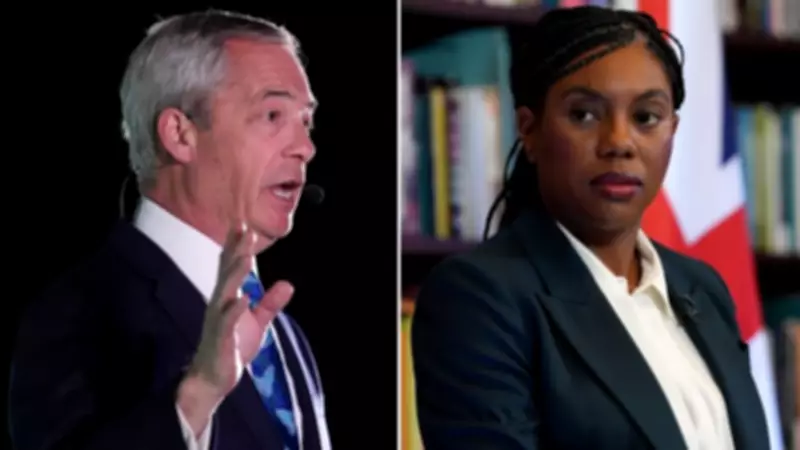
While Conservative leader Kemi Badenoch echoed similar sentiments on social media, Farage's spectacle dominated headlines, highlighting Reform UK's strategy to capture the attention economy. This event symbolizes the intensifying feud between Reform and the Conservatives, with both parties locked in what appears to be a fight to the death for dominance on the right.
Historically, Farage's Brexit Party cooperated with the Conservatives in 2019 to secure Brexit, and he was welcomed at Tory conferences as recently as 2023. However, after taking over Reform UK before the 2024 general election, Farage led the party to win five seats and 14.3% of the vote, while the Conservatives suffered their worst-ever result, reducing their parliamentary ranks to 121. Since then, Reform has gained momentum, winning a by-election, controlling dozens of councils, and attracting disaffected Tories, leapfrogging the Conservatives in over 240 polls.

Defections and Deepening Divides
Robert Jenrick, once a young Tory and cabinet member under Rishi Sunak, has become Farage's right-hand man, representing a significant defection. He explains his departure, stating, "The Tory party hadn't really learned the lessons of the mistakes they made in office. It wasn't changing." Jenrick rejects any notion of a pact with the Conservatives, asserting that the only way to unite the right is "behind Reform and Nigel." He is joined by over 20 former or current parliamentarians, including Danny Kruger, who warns that a split right could allow a "terrible coalition of the left" to win the next election.
Polling data from Ipsos for Sky News reveals complexities in this rivalry. While combined support for Reform and the Conservatives suggests a potential right-wing coalition, only one in four supporters from each party is open to voting for the other. Additionally, pacts on the left enjoy significantly more support, with a +23% net approval compared to +2% on the right, raising the risk that a divided right could be overtaken by a unified left-wing alliance.
Ideological Clashes and Strategic Moves
Luke Tryl, executive director of More in Common UK, notes that Tory and Reform voters are not interchangeable. "Tory voters have much lower approval of Donald Trump," he says, "and on questions about the economy, lots of Reform voters want big nationalisation, while Tories are more sceptical." This distinction underscores the challenge of merging the two factions.
Within the Conservative Party, figures like Amber Rudd advocate for rebuilding from the centre-right, rejecting Farage's policies as damaging. She has helped establish Prosper, a pressure group aimed at galvanising centre-right voters. Meanwhile, Conservative chairman Kevin Hollinrake emphasises creating clear distinctions on economic and welfare policies, labelling Reform as "populism" versus conservatism.
Electoral Implications and Future Prospects
Sky News' Reform Voting Index shows Reform leading in 316 seats across Britain, compared to the Conservatives' 93, with 223 seats too close to call. This advantage positions Reform as the insurgent force on the right, though the Conservatives hope Reform's surge will fade due to local governance issues or "Farage fatigue." Polling indicates Badenoch is more popular among Reform supporters than Farage is among Tory backers, suggesting potential for voter reclamation.

As the May local elections approach, Farage aims to press his advantage, making the battle for the right a central theme leading up to the next general election. This prolonged conflict not only threatens the Conservative Party's survival but also presents Labour with a prime opportunity to secure victory, shaping the future of British politics in unpredictable ways.