Trump's Holy War Against the Vatican
In a remarkable escalation of tensions between political and religious spheres, former President Donald Trump has launched a direct attack on Pope Leo XIV, the head of the Catholic Church. This confrontation comes at a delicate political moment when Catholic swing voters could determine the outcome of future elections.
The Pontiff's Peaceful Protest
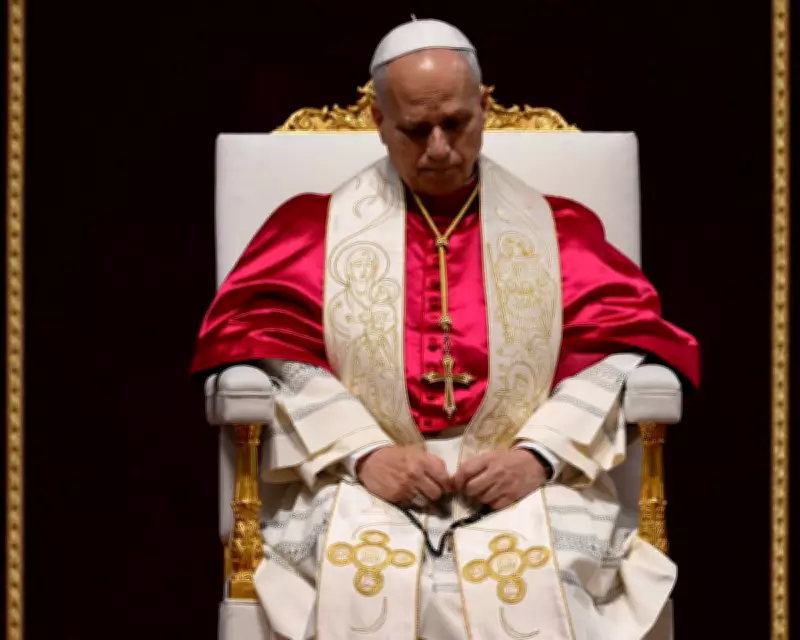
Pope Leo XIV led a solemn vigil for peace at the Vatican on April 11th, invoking the biblical phrase "Blessed are the peacemakers" as he condemned global conflicts. During his address, the pontiff declared that "God does not bless any conflict" and criticized those who "drop bombs" while claiming religious justification.
While the pope didn't mention any world leader by name, his statements were widely interpreted as a rebuke of the Trump administration's foreign policy approach, which has frequently employed religious rhetoric to justify military actions.

Trump's Messianic Complex
The former president responded with characteristic fury on his Truth Social platform, labeling Pope Leo XIV "WEAK on Crime, and terrible for Foreign Policy." This verbal assault was accompanied by an even more controversial move: Trump posted an AI-generated image depicting himself as a Christ-like figure anointing a man resembling Jeffrey Epstein.
Although Trump later deleted the image and claimed it represented him "as a doctor," the damage was already done. The visual representation of Trump in messianic terms, combined with his attack on the spiritual leader of 1.3 billion Catholics, created a perfect storm of controversy.
Catholic Voters: The Ultimate Swing Block
The political implications are significant. Catholic voters represent the largest religious swing voting bloc in the United States, with their support shifting dramatically between elections. While they largely supported President Biden in 2020, Trump had managed to secure a 10- to 20-point margin among Catholic voters in the 2024 election.
"Alienating Catholics is not the smartest move," observed political analysts, noting that Trump's attacks could undermine his party's standing with this crucial demographic. Recent polling indicates that a majority of Catholics already disapprove of Trump's handling of international conflicts, particularly regarding Iran.
JD Vance's Awkward Silence
The controversy has placed Trump's vice president and presumed successor, JD Vance, in an uncomfortable position. As a Catholic himself, Vance initially remained silent about the conflict between his political mentor and spiritual leader.
Denise Murphy McGraw, national co-chair of Catholics Vote Common Good, publicly criticized Vance's silence, stating that "silence is complicity" when religious leaders face political attacks.
When Vance finally addressed the issue on Fox News, he offered a diplomatic but revealing response: "It would be best for the Vatican to stick to matters of morality ... and let the president of the United States stick to dictating American public policy."
Media Amplification and Religious Tensions
The conflict gained additional momentum when Sean Hannity, Trump's close ally at Fox News, declared "I hate the pope" and questioned whether the pontiff had "even read the Bible." This media amplification transformed what might have been a passing controversy into a sustained confrontation between conservative media and religious authority.
Pope Leo XIV responded with characteristic grace, reiterating that "Blessed are the peacemakers" and stating, "I'm not afraid of the Trump administration or of speaking out loudly about the message of the Gospel."
Long-Term Political Consequences
Political observers note that while Trump himself may not face immediate electoral consequences, his attacks could complicate JD Vance's future political ambitions. As the presumed heir to Trump's political movement, Vance must navigate the delicate balance between maintaining his Catholic identity and supporting his political mentor.

The incident highlights the growing tension between religious values and political loyalty in American politics, with Catholic voters increasingly caught between their spiritual convictions and partisan affiliations. As the 2028 election approaches, how Vance handles this religious-political divide may determine his viability as a national candidate.
Meanwhile, the spectacle of a former president attacking the leader of the world's largest Christian denomination while portraying himself in messianic terms represents a new frontier in the intersection of religion, politics, and digital media in American public life.