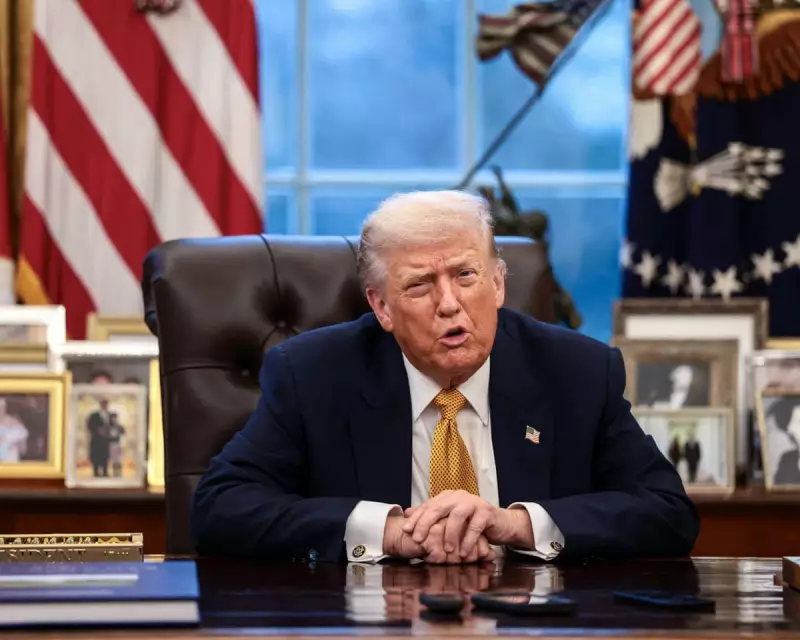
As tensions in the Middle East appeared to momentarily subside this week, the underlying volatility of Donald Trump's presidency was thrown into sharp relief. The US president, having threatened military action, stepped back from striking Iran, citing a halt in the killing of protesters. Yet this reprieve masks a brutal reality and a foreign policy approach that grows increasingly capricious and dangerous.
A Pattern of Unpredictability and Its Global Repercussions
Despite a telecommunications blackout, reports from Iran paint a grim picture. Human rights groups suggest thousands have been killed and countless more arrested in a severe crackdown on recent protests, with one official mentioning a death toll of around 2,000. The streets, described by witnesses as resembling a war zone, have quieted largely because citizens have been terrorised into staying indoors. Iran's foreign minister took the calculated step of appearing on Fox News to deny imminent executions, a message tailored for a specific audience in the White House.
While retribution may be delayed, the regime views the calls for its downfall as an existential threat and is merely waiting. For Mr Trump, the episode is another move in a game where the spectacle of threat often supersedes follow-through. This tactic, however, has profound consequences. As one leading Iran analyst observed, US policymaking has devolved from a strategic, deliberative process to a bureaucracy scrambling to react to the president's off-the-cuff remarks.

From the Persian Gulf to the Arctic: A Scattergun Approach
Even as the immediate threat to Iran receded, another flashpoint emerged far to the north. On Thursday, the arrival of European troops in Greenland underscored the diplomatic crisis ignited by Mr Trump's expressed desire to purchase the autonomous Danish territory. Meetings in Washington failed to resolve what Denmark's Foreign Minister, Lars Løkke Rasmussen, termed a "fundamental disagreement," with the president reiterating that America "needs" Greenland and the Danish minister warning of a US intent to "conquer" it.
Meanwhile, Venezuela simmers on a back burner after Mr Trump's controversial decision to recognise opposition leader Juan Guaidó, a move he celebrated as a victory over Nicolás Maduro. The president has since issued warnings to Cuba, Colombia, and Mexico, suggesting they could be next in his sights. Alarmingly, the former sceptic of foreign interventions now seems convinced that such adventures carry fewer costs and greater political rewards than he once thought.
The 'Madman Theory' Without the Strategy
This approach echoes, yet dangerously distorts, Richard Nixon's so-called "madman theory," where projecting an image of volatility was intended to keep adversaries off-balance. Crucially, Nixon operated within a clear strategic framework. Mr Trump does not. His causes—whether resource acquisition, imperial grandeur, vengeance, or self-glorification—are alarming in their vagueness and self-interest. His idea of victory is short-term and egocentric, and his administration is ruled by caprice.
It is telling that in the case of Iran, it was the country's regional rivals, fearful of catastrophic destabilisation, who were key in urging restraint. The president is emboldened by what he perceives as a success in Venezuela and is thus more likely to miscalculate. He delights in keeping not only international observers but also his own inner circle unsettled.
In a speech to the French army on Thursday, President Emmanuel Macron spoke of a world where "destabilising forces have awakened" and old certainties have vanished. He did not need to name the primary source of this disruption. For the United States and the world, the permacrisis is not merely a result of Trump's presidency—it is his chosen method.