

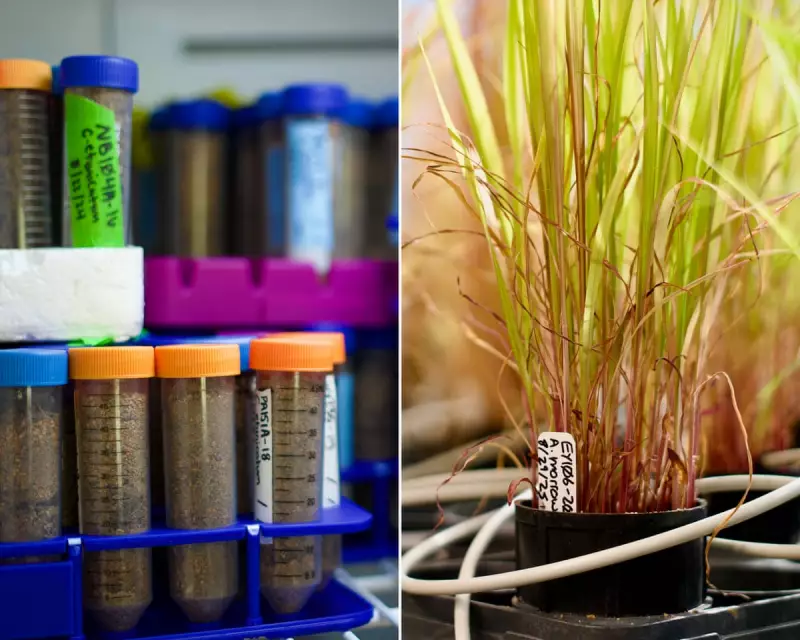
Deep within a University of Kansas greenhouse, a quiet crisis is unfolding. Rows of sudan grass, each harbouring a unique, invisible fungal ally in its roots, represent a global treasure now under threat. This is the International Collection of Vesicular Arbuscular Mycorrhizal Fungi (INVAM), the planet's most extensive living library of soil fungi. After four decades of painstaking work, this irreplaceable resource could vanish within a year due to devastating federal budget cuts.
A Living Library of 'Vital Ecosystem Engineers'
INVAM is no ordinary collection. It maintains living spores from more than 900 distinct fungal strains, gathered from six continents. These arbuscular mycorrhizal (AM) fungi form symbiotic partnerships with roughly 70% of all land plants. In exchange for sugars, they supply essential nutrients like phosphorus and nitrogen, bolster plants against drought and disease, and act as a significant underground carbon sink.
For leading scientists, its potential loss is unthinkable. "INVAM represents a library of hundreds of millions of years of evolution," said mycologist Toby Kiers, executive director of the Society for Protection of Underground Networks (Spun). "Ending INVAM for scientists is like closing the Louvre for artists." Established in 1985, the collection has survived solely on successive federal grants. Its latest funding from the US National Science Foundation (NSF) ended in May 2024.

The future looks bleak. The Trump administration's proposed budget for fiscal year 2026 would slash NSF funding by a staggering 57%. Curator Professor Jim Bever is preparing a new grant proposal but acknowledges the grim reality. Without fresh funding, he estimates the collection might survive for another year on temporary grants and volunteer labour. "I have a hard time thinking about that possibility," Bever admitted, "but we can't deny it's true."
The Delicate Art of Preserving an Underground World
Preserving this library is an arcane and relentless task. Unlike seeds in a vault, AM fungal spores cannot be stored indefinitely. They require annual, meticulous cultivation. Associate curator Dr Terra Lubin isolates glistening spores under a microscope, then paints them onto the roots of sterile sudan grass seedlings.
These host plants grow for 12 weeks, allowing the fungi to colonise. They are then stressed by drought, triggering the fungus to produce millions of new spores, which are harvested and stored in a cold room. This entire, delicate process must be repeated for every one of the 900-plus strains, every single year. "There really isn't another lab in the US that has been doing this," said Bever, highlighting the unique and endangered skillset at INVAM.
Contrasting Real Science with a Failing Biofertiliser Market
The precarious state of public research stands in stark contrast to a booming yet broken commercial market. Bever and colleague Professor Liz Koziol's 2024 meta-analysis revealed a shocking truth: the majority of commercial AM fungus biofertilisers are worthless. Testing 23 products, they found 87% failed to colonise plant roots, many contained dead spores or pathogens, and some had no spores at all.
This failure wastes a global market worth $1.29bn and leaves farmers and land managers without effective tools. Bever points to a lack of regulation and the specialised expertise needed to steward these organisms—expertise that public institutions like INVAM hold but are struggling to maintain.
Yet, when applied correctly, the power of these fungi is transformative. On a research plot in Lawrence, Kansas, a tired hay field has been reborn as a vibrant tall-grass prairie over nine years, solely through the reintroduction of native AM fungi. Control plots without the fungi remain impoverished. Modern agriculture, with its fungicides, synthetic fertilisers, and ploughing, decimates these vital networks. "We can barely even find the DNA [of AM fungi] in some of the soils that have been in intensive agricultural production," said fungal ecologist Matthias Rillig.

This research points to immense potential: restoring native ecosystems, boosting the success of conservation programmes like the US Conservation Reserve Program, and aiding sustainable agriculture. Koziol's spin-out, MycoBloom, already shows promise, with high-quality fungal preparations delivering results in vineyards, orchards, and organic farms.
The call from the scientific community is urgent and unified. Merlin Sheldrake, author of Entangled Life, stated: "These organisms are vital ecosystem engineers that hold the key to so many problems we face. To lose this library would be an unimaginable tragedy." As federal funding for basic science dwindles, the world risks losing a foundational resource for understanding and healing our planet's stressed ecosystems.





