

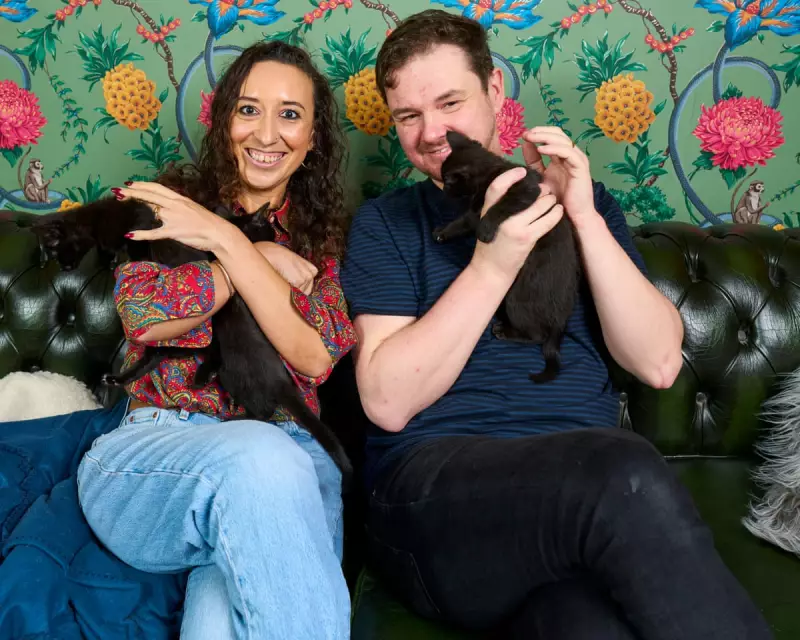
What began as a plan to adopt a single kitten for companionship has spiralled into a full-scale feline rescue operation for one Manchester couple, starkly illustrating a nationwide crisis in cat abandonment.
From Two Cats to a Crowded House
Hannah Al-Othman and her husband, Michael, started with one grumpy ginger cat named Phillip. Last summer, they decided he needed a friend. Contacting a local rescue centre, they were persuaded to take not one, but two kittens—sisters named Joanne and Susan. The trio, named after members of the band The Human League, brought their household to a socially acceptable total of two cats.
Their life in a two-bedroom terrace in Levenshulme, Manchester, was peaceful until September. A neighbour, Viv, knocked on their back door having discovered three five-day-old black kittens in a carrier in the alley behind their homes. Hannah immediately tried cat rescue charities, but every single one was full. The RSPCA explained they could not help as the cats were not sick or injured.

"My options, it transpired, were 'leave them there or take them in'," Hannah recounts. They chose the latter, taking in the three kittens—Leslie, Stevie, and Toni—and their mother, who they named Phillipa (later Pippa). Their cat count jumped to seven.
A Crisis Spilling into Alleys and Homes
The situation in their alleyway had escalated from the occasional stray to a burgeoning colony. With help from Cats Protection, seven cats living in the alley were trapped, neutered, and returned. Hannah managed to find homes for three of them. Just as things settled in late October, another message arrived on the local WhatsApp group: a mother cat and four 12-week-old kittens were found nearby.
The owner of the mother cat said she was "trying to get rid of them" and surrendered the kittens. Hannah and Michael found themselves walking home with a second litter, bringing the total number of cats in their house to an overwhelming 11.
The logistical and physical strain was immediate. With an open-plan downstairs and a cat flap for their original pets, the new, unvaccinated arrivals had to be kept upstairs. The first litter occupied the spare room, forcing the second litter into the couple's only bathroom. "After experiencing the least peaceful bath of my life," Hannah says, she didn't attempt another until they were rehomed.
A National Problem with Local Consequences
This personal story is a microcosm of a severe UK-wide issue. Animal charities report being at capacity due to a surge in stray and abandoned cats. SuiLi Weight, a senior manager at Cats Protection, states that around 5,100 stray cats came into their care in the last year, representing 18% of all intakes. Centres regularly reach capacity.
Alice Potter, cat welfare expert at the RSPCA, directly links the crisis to the soaring cost of living and a decline in neutering. "Many owners are struggling with vet costs or delaying neutering, which has led to more unwanted litters," she explains. Neutering rates have fallen to 82% from 88% in 2020, with younger owners (aged 18-34) far less likely to neuter their pets.
The consequences are mathematical and rapid. A single female cat can breed from four months old and produce up to 18 kittens a year. "Numbers can quickly spiral," Potter warns—a fact the Manchester couple knows all too well.
Thankfully, the second litter of kittens was old enough to be rehomed quickly. Pippa's kittens will soon go to new homes, which should bring Hannah and Michael's count down to four. Yet, they live with the anxiety that it's only a matter of time before another desperate litter appears. As one neighbour collecting kittens remarked, "What's three when you've already got one?"—a line of thinking Hannah now recognises as the very slippery slope that led to 11 cats in a two-bedroom house.






