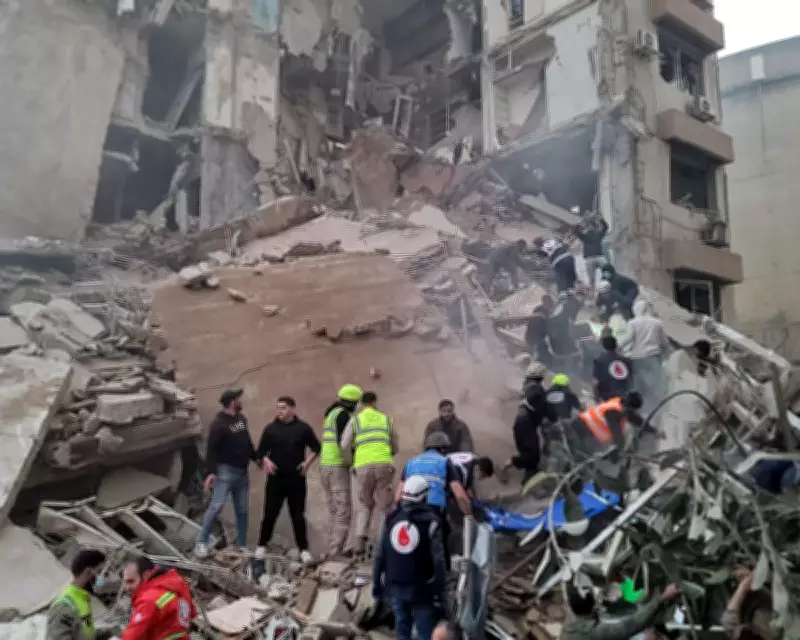
First responders and local residents gathered at the site of an Israeli airstrike in Beirut's Tallet al-Khayyat neighborhood on April 8, 2026, highlighting the ongoing regional tensions. Photograph: Fadel Itani/AFP/Getty. The concept of 'Greater Israel,' often invoked by the Israeli right, is frequently perceived as a purely territorial ambition to expand Israel's claimed land. However, this interpretation only scratches the surface of a much broader and more sophisticated geopolitical strategy.
The Territorial Foundation of Greater Israel
Since its inception, Israel has pursued expansionist policies, resulting in the displacement and dispossession of Palestinians. In recent years, this process has accelerated dramatically. Over the past two-and-a-half years, Israel has flattened and reconquered Gaza, leading to tens of thousands of casualties and devastating civilian infrastructure, forcing the population into just 12% of the already tiny strip of land, according to estimates from last year.
In the West Bank, Israel continues an unprecedented campaign of destruction and displacement against Palestinian people and property, expanding its control and settlements at a rate not seen since the 1967 Six-Day War. Following the fall of President Bashar al-Assad in 2024, Israel seized territory in Syria beyond the illegally annexed Golan Heights and is actively reconstituting an occupation zone in southern Lebanon.

Government ministers from the Religious Zionism and Jewish Power factions, along with Likud parliamentarians, openly advocate for Israeli sovereignty and settlement in Lebanon. Finance Minister Bezalel Smotrich has called for Israel to 'expand to Damascus,' and Prime Minister Benjamin Netanyahu has expressed a strong connection to this territorial vision of Greater Israel.
The Geopolitical Ambition Behind Greater Israel
Beyond mere land acquisition, Greater Israel represents a strategic concept aimed at establishing regional dominance. Netanyahu's vision is not limited to controlling territory but involves creating a project of dominion built on new alliances and hard power dependency. This ambition became clearer after the October 7 attacks, when Israel's efforts at regional normalization with Arab neighbors stalled due to its harsh response in Gaza.
Faced with a choice between resuming normalization efforts through a more accommodating approach to Palestinians or doubling down on a zero-sum negation of their future, Netanyahu opted for the latter. This decision required removing Iran as a regional power balancer, necessitating direct and massive U.S. military engagement alongside Israel.
Strategic Alliances and Regional Control
In the days leading up to the Iran war, former Israeli security figures noted that weakening Iran significantly would establish Israel as the 'dominant regional power.' Achieving this goal involves not only collapsing Iran but also weakening Gulf Cooperation Council (GCC) states—Bahrain, Kuwait, Oman, Qatar, Saudi Arabia, and the United Arab Emirates—making them dependent on Israel for security and energy export routes.
The spillover effects of the war, with GCC states hit by Iranian drones and missiles, appear to be an intentional design feature for Israel, not a regrettable side-effect. When Israel and the U.S. launched the war, GCC access to global markets via the Strait of Hormuz was severely impacted. Netanyahu capitalized on this by calling for alternative routes, such as oil and gas pipelines through the Arabian Peninsula to Israeli Mediterranean ports.
Building a Hexagon of Alliances
Netanyahu has publicly outlined his vision for a 'hexagon of alliances' including India, Arab nations, African nations, Mediterranean nations like Greece and Cyprus, and Asian nations, with Israel as the key nodal point. A recent Hebrew publication from high-ranking figures at the Israel Defense Forces' strategy institute elaborated on this, suggesting Israel would achieve 'operational control even in areas far from Israel's borders, without occupying and holding territory,' establishing a 'superior status as a kind of 'queen' of the jungle.'

In recent speeches, Netanyahu has referred to Israel not only as a 'regional superpower' but 'in some respects, a global superpower.' This alliance aims to be sustainable even if U.S. power draws down, targeting what Netanyahu calls the 'radical Shia axis' and the 'emerging radical Sunni axis,' with Turkey named as the next potential threat.
Risks and Implications of Greater Israel Dominion
While talk of Greater Israel dominion might be dismissed as wartime hyperbole, recent Israeli policy indicates it is a serious and dangerous ambition. A permanent war orientation is deeply ingrained in Israel's political class, security establishment, and media, but this thinking carries significant risks of overreach and blowback, posing dangers for Israel itself and likely facing rejection from the region.
In the postwar landscape, deterring and containing this project of Greater Israel dominion may be among the most critical challenges. Daniel Levy, a political commentator and president of the U.S./Middle East Project who served as an Israeli peace negotiator at the Oslo II talks, emphasizes the importance of addressing this issue to prevent further escalation and instability in the Middle East.