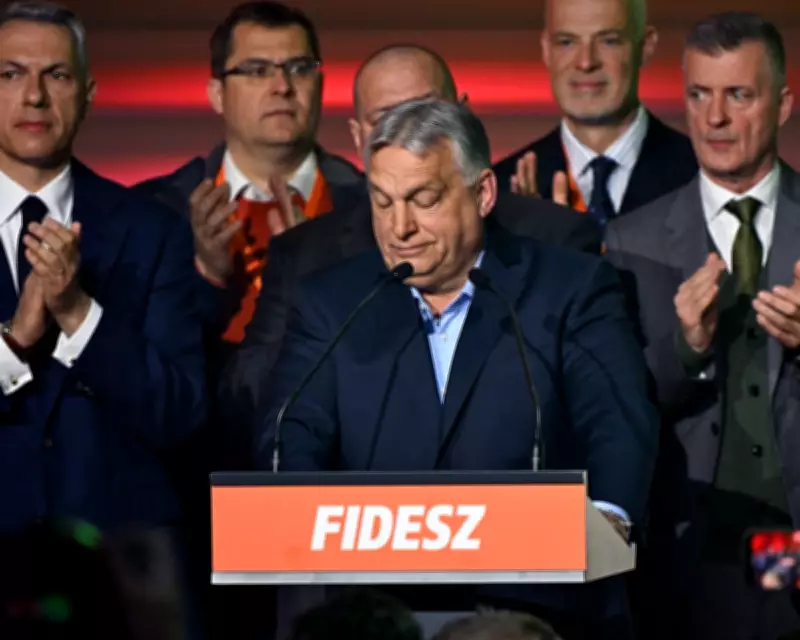
Viktor Orbán Concedes Defeat to Péter Magyar in Historic Hungarian Election
In a stunning political reversal, Hungary's former prime minister, Viktor Orbán, conceded defeat to Péter Magyar at the Balna centre in Budapest on April 12, 2026. This event marks the end of Orbán's 16-year rule, delivering a seismic shift in Hungarian politics with profound implications for Europe and beyond.
A Decisive Victory and Its Domestic Ramifications
On a record turnout of 77%, Hungarians handed Péter Magyar's Tisza party a decisive victory, providing the first real opportunity in over a decade to dismantle the system built by Orbán. Zsuzsanna Szelényi, programme director of the CEU Democracy Institute, notes that the foundations of Fidesz had been cracking for some time, exacerbated by a 2024 political scandal and economic mismanagement. Magyar's rise was fueled by growing public anger over the regime's pro-Russian, anti-European stance and a sense of political entrapment.
Magyar campaigned with relentless energy across the country, using conservative-populist language to insulate himself from attacks and framing the election as a choice between "east or west." In his victory speech, he promised to restore the rule of law and repair relations with the EU and NATO. However, fulfilling these promises will be extraordinarily difficult. Orbán's system has deeply infiltrated the state, media, economy, and political culture, meaning that dismantling Orbánism poses a significant challenge beyond merely removing him from office.

European and Global Implications of Orbán's Fall
Nathalie Tocci, an international relations expert, emphasizes that this election is as significant outside Hungary as within it. Orbán's defeat removes a thorn in the EU's side, particularly regarding Ukraine, and marks a victory for liberalism globally. Orbán has served as a model for far-right politicians across Europe and the US, making his loss a symbolic blow to nationalist movements.
Cas Mudde, a professor at the University of Georgia, points out that while the result has strong symbolic value, it should not be overinterpreted as the end of the far right in Europe. Orbán's acceptance of the result highlights the exceptional nature of figures like Donald Trump, who refused to concede defeat. Nevertheless, Orbán's absence creates a void in the European far right, as no other leader currently possesses his intent, power, or resources to fill it.
Challenges and Opportunities for the EU
Zselyke Csaky, a senior research fellow at the Centre for European Reform, warns that the EU must urgently develop a coherent strategy to tackle democratic backsliding within its ranks. The union's existing mechanisms, such as the article 7 process and frozen funds, have proven insufficient against Orbán's regime. Magyar's victory offers Europe a chance to strengthen its approach, support Ukraine more effectively, and reform decision-making processes to prevent individual member states from holding the continent hostage.
Hungary's Future Under Péter Magyar
Mujtaba Rahman, Eurasia Group's managing director for Europe, describes Magyar's landslide as historic, projecting a two-thirds constitutional majority for Tisza. This will enable the new government to begin unraveling Orbán's control over institutions like the judiciary and media. Magyar is expected to release blocked EU funds, reverse Orbán's veto on aid for Ukraine, and dismantle bodies like the Sovereignty Protection Office.
However, challenges loom large. The Magyar team lacks governing experience, and public expectations are immense. Economic pressures, including lavish pre-election spending, will limit budgetary freedom, and the grace period for the new administration may be short-lived. Despite these hurdles, the election has crossed a decisive threshold, demonstrating that even entrenched illiberal regimes are not invincible.
In summary, Orbán's defeat represents a pivotal moment for Hungary and Europe, offering hope for democratic renewal but also underscoring the difficult path ahead in repairing the political, legal, and moral wreckage left behind.