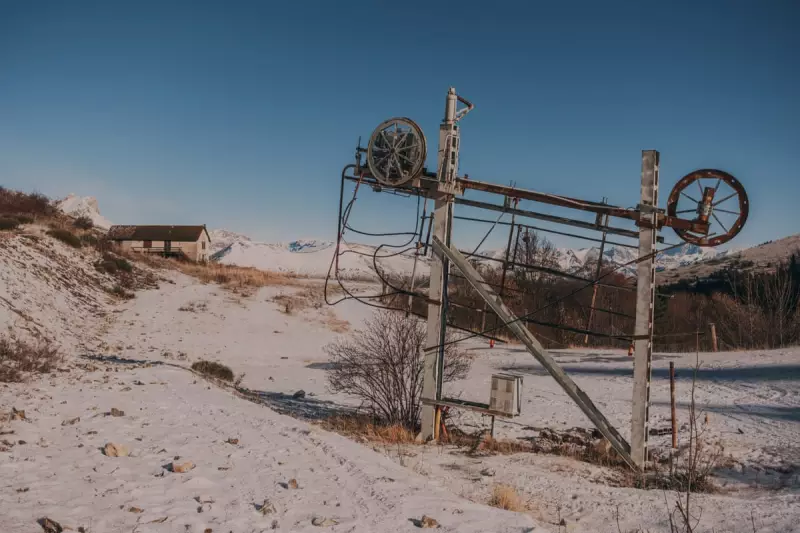
The skeletal remains of ski lifts stand silent against the alpine sky at Céüze 2000, a poignant monument to a vanishing way of life. This resort in France's Hautes-Alpes department, which operated for 85 years, never reopened after its final season in March 2018. Successive winters with dwindling snowfall rendered it financially unviable, leaving behind a frozen snapshot of its last day.
The Final Day Frozen in Time
When workers left at the end of the 2018 season, they assumed they would return. A staff rota remains pinned to a wall, maps of the pistes are stacked beside a stapler, and a yellowing newspaper dated 8 March 2018 sits folded nearby. A half-drunk bottle of water still rests on a table, as if its owner might return any moment. Céüze is now one of more than 186 French ski resorts permanently closed, creating a new landscape of 'ghost stations' across the Alps.
The resort's decline began in the 1990s as snowfall became unreliable. To break even, it needed a three-month season. In its final winter, it managed just six weeks, following two years where it could not open at all. The local authority faced costs of up to €450,000 (£390,000) to open each season. As the operational window shrank, the financial logic collapsed. "It was costing us more to keep it open than to keep it closed," stated Michel Ricou-Charles, president of the Buëch-Dévoluy community council.

A Toxic Legacy and the Fight for Reclamation
The abandonment raises urgent questions about the environmental legacy left behind. Across France, 113 ski lifts, totalling nearly 40 miles in length, have been abandoned, with nearly three-quarters located in protected areas. The issue extends beyond skiing. The Mountain Wilderness association estimates over 3,000 abandoned structures litter the French mountains, including military and industrial waste.
At Céüze, pollution is already evident. A small cabin sheds insulation, tattered ropes dangle, and plastic flakes off pylons. Old sheds often contain hazardous materials like asbestos, motor oils, and transformers, which can seep into soil and water. "In Latin, we say memento mori – remember that you are mortal," says Nicolas Masson of Mountain Wilderness. "Don't think you are making eternal things; they will become obsolete."
The complex and costly process of removal means most infrastructure is left to rot. Dismantling Céüze, which began in November 2025, cost €123,000 and required helicopters to airlift pylons out, minimising ground disturbance.
Nature's Tentative Return
With the resort closed for seven years and the lifts now gone, early signs of ecological recovery are emerging. Dog rose shrubs, their red winter berries a vital food source for birds like the rare red-billed chough, now sprout on the unmown piste. In summer, orchids and gentians bloom. The surrounding hills are a Natura 2000 site, home to Europe's most protected wildlife.
"I don't know if it would take 10, 20 or 50 years, but this is becoming a forest," observes Masson. Wildlife such as wild boar, roe deer, and the endangered grouse, which shelters in deep snow, may benefit from quieter winters. However, ecologists note that recovery is not straightforward. Maintaining pistes can help some alpine flowers, while completely wild regrowth risks invasion by stronger, non-native species.
Studies from a resort closed in Spain's Sierra de Guadarrama in 1999 show promising recovery of native vegetation and cleaner waterways. "These are laboratories of what the mountain could be like in the future with new closures," says geographer Pierre-Alexandre Métral of the University of Grenoble Alpes.
A Future Facing the Entire Alps
The fate of Céüze is a harbinger for the region. Research indicates that with 2C of global heating, over half of Alpine resorts risk having insufficient snow. Lower-altitude resorts are most vulnerable, but even higher ones face threats from melting permafrost destabilising lift pylons. Some, like St-Honoré 1500, were abandoned mid-construction.

Not everyone accepts the closure. Local resident Richard Klein believes the family-friendly resort could have been saved with artificial snow. "I think it's really stupid they closed it," he said. Yet, life persists in new forms. The Hotel Galliard is set for redevelopment, and on winter weekends, the car park fills with people walking, snow-shoeing, and sledging.
Masson rejects the term 'ghost resort', arguing it suggests total abandonment. "People continue to come," he says. "We don't need large machines to make mountains attractive." The fundamental question remains for communities across Europe: What parts of our mountain heritage do we preserve, and what do we dismantle to make space for nature's return?